Instructions to use stepfun-ai/RLVR-8B-0926 with libraries, inference providers, notebooks, and local apps. Follow these links to get started.
- Libraries
- Transformers
How to use stepfun-ai/RLVR-8B-0926 with Transformers:
# Use a pipeline as a high-level helper from transformers import pipeline pipe = pipeline("text-generation", model="stepfun-ai/RLVR-8B-0926") messages = [ {"role": "user", "content": "Who are you?"}, ] pipe(messages)# Load model directly from transformers import AutoTokenizer, AutoModelForCausalLM tokenizer = AutoTokenizer.from_pretrained("stepfun-ai/RLVR-8B-0926") model = AutoModelForCausalLM.from_pretrained("stepfun-ai/RLVR-8B-0926") messages = [ {"role": "user", "content": "Who are you?"}, ] inputs = tokenizer.apply_chat_template( messages, add_generation_prompt=True, tokenize=True, return_dict=True, return_tensors="pt", ).to(model.device) outputs = model.generate(**inputs, max_new_tokens=40) print(tokenizer.decode(outputs[0][inputs["input_ids"].shape[-1]:])) - Notebooks
- Google Colab
- Kaggle
- Local Apps
- vLLM
How to use stepfun-ai/RLVR-8B-0926 with vLLM:
Install from pip and serve model
# Install vLLM from pip: pip install vllm # Start the vLLM server: vllm serve "stepfun-ai/RLVR-8B-0926" # Call the server using curl (OpenAI-compatible API): curl -X POST "http://localhost:8000/v1/chat/completions" \ -H "Content-Type: application/json" \ --data '{ "model": "stepfun-ai/RLVR-8B-0926", "messages": [ { "role": "user", "content": "What is the capital of France?" } ] }'Use Docker
docker model run hf.co/stepfun-ai/RLVR-8B-0926
- SGLang
How to use stepfun-ai/RLVR-8B-0926 with SGLang:
Install from pip and serve model
# Install SGLang from pip: pip install sglang # Start the SGLang server: python3 -m sglang.launch_server \ --model-path "stepfun-ai/RLVR-8B-0926" \ --host 0.0.0.0 \ --port 30000 # Call the server using curl (OpenAI-compatible API): curl -X POST "http://localhost:30000/v1/chat/completions" \ -H "Content-Type: application/json" \ --data '{ "model": "stepfun-ai/RLVR-8B-0926", "messages": [ { "role": "user", "content": "What is the capital of France?" } ] }'Use Docker images
docker run --gpus all \ --shm-size 32g \ -p 30000:30000 \ -v ~/.cache/huggingface:/root/.cache/huggingface \ --env "HF_TOKEN=<secret>" \ --ipc=host \ lmsysorg/sglang:latest \ python3 -m sglang.launch_server \ --model-path "stepfun-ai/RLVR-8B-0926" \ --host 0.0.0.0 \ --port 30000 # Call the server using curl (OpenAI-compatible API): curl -X POST "http://localhost:30000/v1/chat/completions" \ -H "Content-Type: application/json" \ --data '{ "model": "stepfun-ai/RLVR-8B-0926", "messages": [ { "role": "user", "content": "What is the capital of France?" } ] }' - Docker Model Runner
How to use stepfun-ai/RLVR-8B-0926 with Docker Model Runner:
docker model run hf.co/stepfun-ai/RLVR-8B-0926
PaCoRe: Learning to Scale Test-Time Compute with Parallel Coordinated Reasoning
📖 Overview
We introduce PaCoRe (Parallel Coordinated Reasoning), a framework that shifts the driver of inference from sequential depth to coordinated parallel breadth, breaking the model context limitation and massively scaling test time compute:
- Think in Parallel: PaCoRe launches massive parallel exploration trajectories.
- Coordinate in Multi-rounds: It employs a message-passing architecture to compact these thoughts into concise messages and synthesize them to guide the next round.
Trained via large-scale, outcome-based reinforcement learning, PaCoRe masters the Reasoning Synthesis capabilities required to reconcile diverse parallel insights.
The approach yields strong improvements across diverse domains, and notably pushes reasoning beyond frontier systems in mathematics: an 8B model reaches 94.5% on HMMT 2025, surpassing GPT-5’s 93.2% by scaling effective TTC to roughly two million tokens.
We open-source model checkpoints, training data, and the full inference pipeline to accelerate follow-up work!
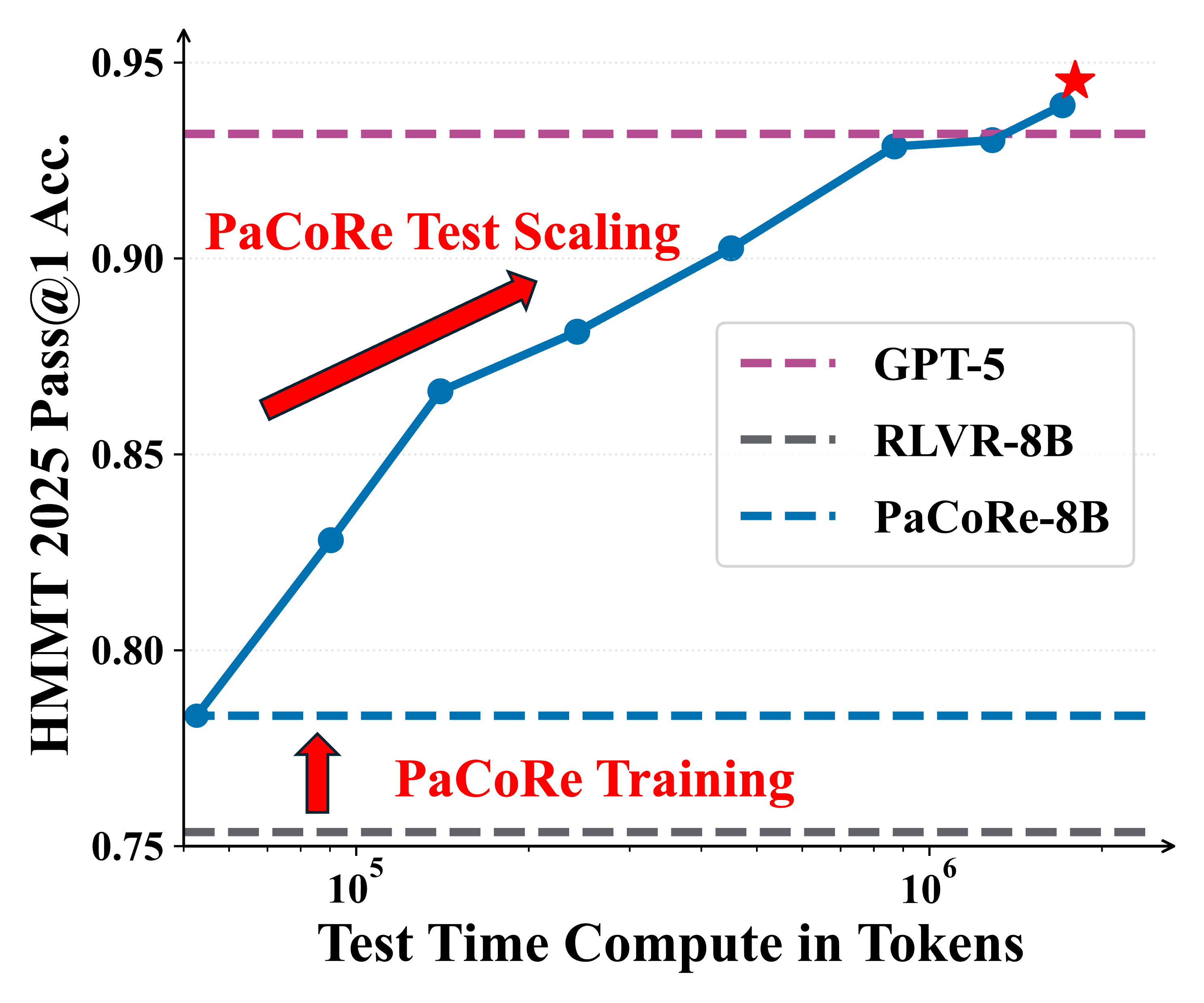
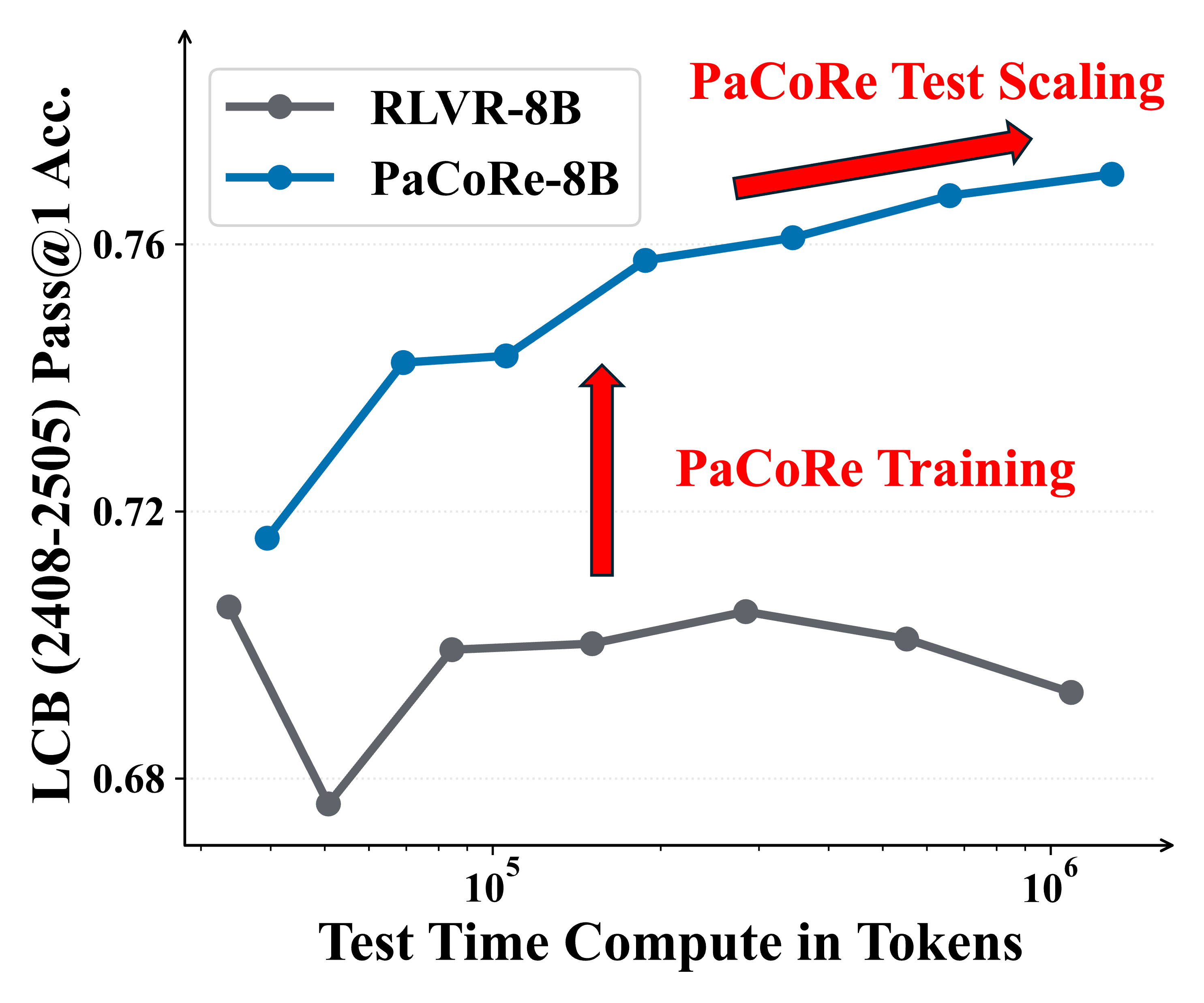
Figure 1 | Parallel Coordinated Reasoning (PaCoRe) performance. Left: On HMMT 2025, PaCoRe-8B demonstrates remarkable test-time scaling, yielding steady gains and ultimately surpassing GPT-5. Right: On LiveCodeBench, the RLVR-8B model fails to leverage increased test-time compute, while PaCoRe-8B model effectively unlocks substantial gains as the test-time compute increases.
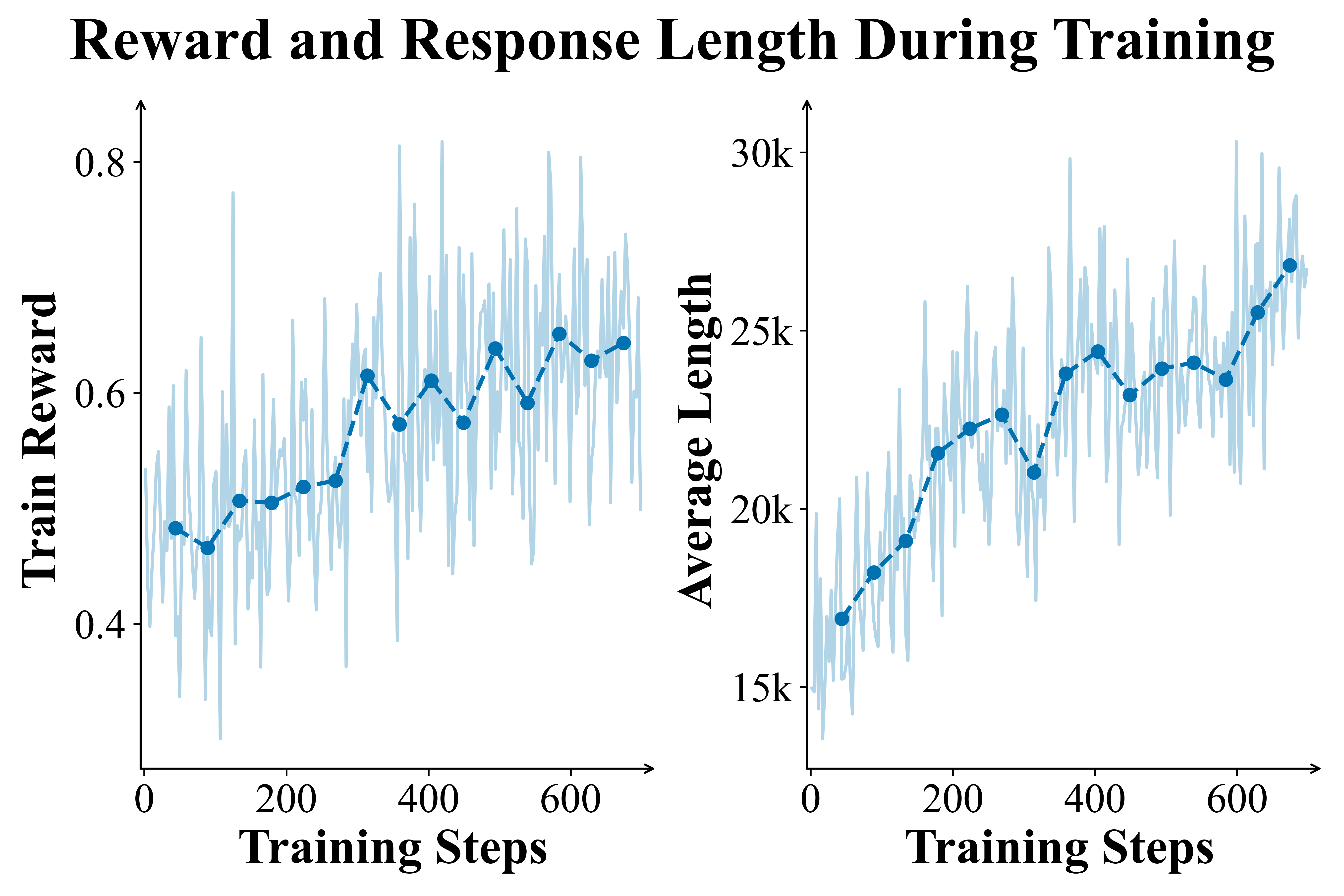
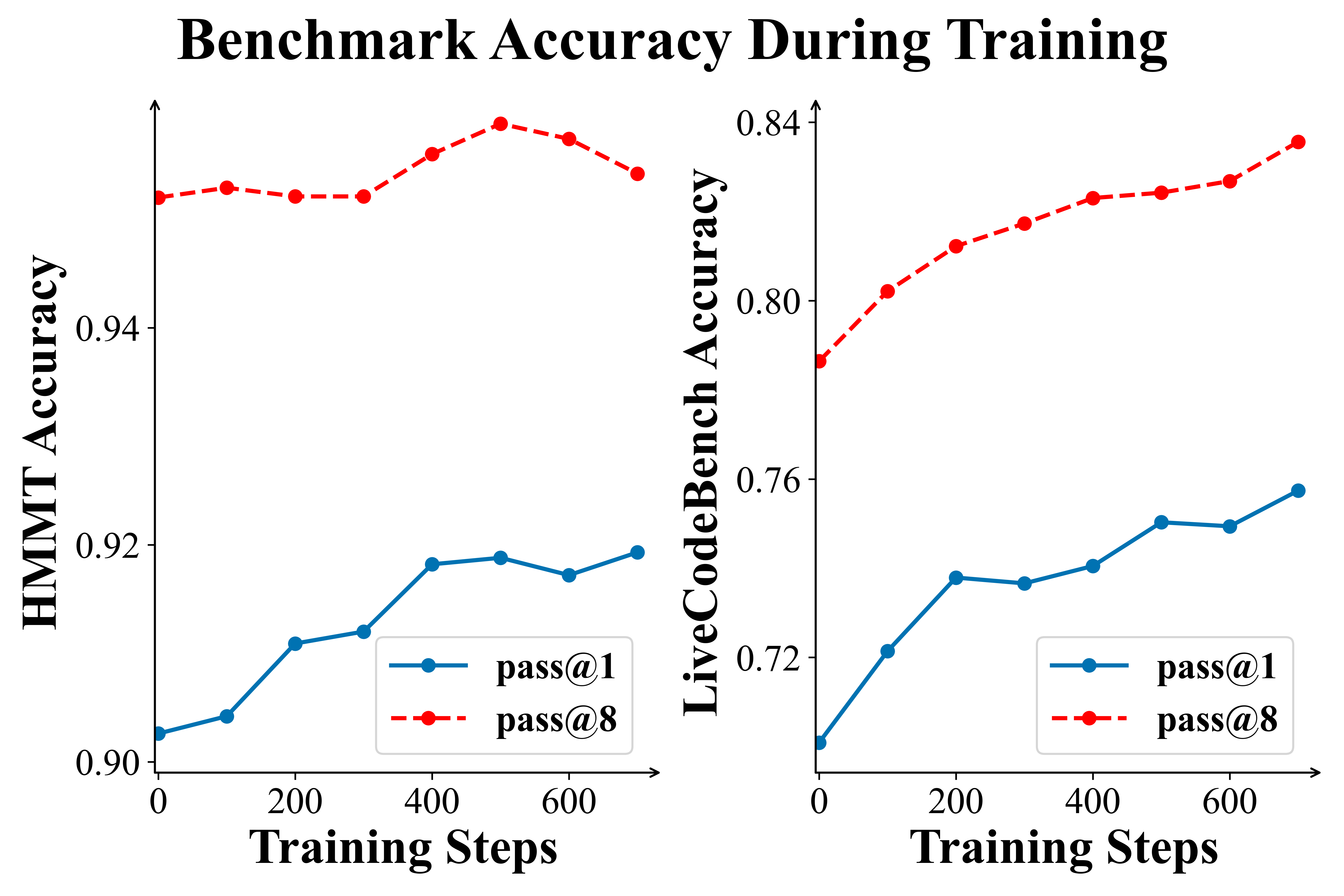
Figure 2 | PaCoRe Training dynamics. Left panels: The Training Reward and Response Length steadily increase, demonstrating the training stability and effectiveness. Right panels: Evaluation on HMMT 2025 and LiveCodeBench (2408-2505). Performance is reported using single round coordinated reasoning in PaCoRe inference setting with $\vec{K} = [16]$.
🔥 Releases
[2025/12/09] We are excited to release the PaCoRe-8B ecosystem:
- 📝 In-depth Technical Report: PaCoRe: Learning to Scale Test-Time Compute with Parallel Coordinated Reasoning.
- 🤖 Model:
- PaCoRe-8B: Our final PaCoRe-trained model checkpoint!
- RLVR-8B-0926: The initial checkpoint of our study, conducted strong reasoning-oriented post-trained on Qwen3-8B-Base.
- 📚 Data: PaCoRe-Train-8k The high-quality training corpus, including
opensource_math,public_mathcontest,synthetic_mathandcode:- 🤗 Stage1-3k: PaCoRe-Train-Stage1-3k
- 🤗 Stage2-5k: PaCoRe-Train-Stage2-5k
🔍 Experiments
| HMMT 2025 | LiveCodeBench (2408-2505) | HLEtext | MultiChallenge | |
|---|---|---|---|---|
| GPT-5 | 93.2 (16k) | 83.5 (13k) | 26.0 (14k) | 71.1 (5.0k) |
| Qwen3-235B-Thinking | 82.3 (32k) | 74.5 (21k) | 18.2 (23k) | 60.3 (1.6k) |
| GLM-4.6 | 88.7 (25k) | 79.5 (19k) | 17.2 (21k) | 54.9 (2.2k) |
| DeepSeek-v3.1-Terminus | 86.1 (20k) | 74.9 (11k) | 19.3 (18k) | 54.4 (1.1k) |
| Kimi-K2-Thinking | 86.5 (33k) | 79.2 (25k) | 23.9 (29k) | 66.4 (1.7k) |
| RLVR-8B | 75.4 (48k) | 70.6 (34k) | 9.3 (35k) | 33.3 (1.7k) |
| PaCoRe-8B (low) | 88.2 (243k) | 75.8 (188k) | 13.0 (196k) | 41.8 (13k) |
| PaCoRe-8B (medium) | 92.9 (869k) | 76.7 (659k) | 14.6 (694k) | 45.7 (45k) |
| PaCoRe-8B (high) | 94.5 (1796k) | 78.2 (1391k) | 16.2 (1451k) | 47.0 (95k) |
Table 1 | For each benchmark, we report accuracy together with total TTC (in thousands). For Low, Medium, and High, we apply the inference trajectory configuration as $\vec{K}=[4]$, $[16]$, and $[32, 4]$ separately.
Key Findings
- Message Passing Unlocks Scaling. Without compaction, performance flatlines at the context limit. PaCoRe breaks the memory barrier and lets reasoning scale freely.
- Breadth > Depth. All compute is not equal. Coordinated parallel reasoning delivers far higher returns than extending a single chain.
- Data as a Force Multiplier. The PaCoRe corpus provides exceptionally valuable supervision—even baseline models see substantial gains when trained on it.
Getting Started 🚀
Installation
First, install the package from the official repository:
pip install -e .
Model Serving
You can directly use vllm serve to serve the model:
vllm serve stepfun-ai/PaCoRe-8B
Inference Example
Next, you can run our example inference code with PaCoRe-low inference setting:
python playground/example_batch_inference_pacore_low_1210.py
🙏 Acknowledgements
- This work was supported by computing resources and infrastructure provided by StepFun and Tsinghua University.
- We are built on amazing open source models and data; thanks again!
📜 Citation
@misc{pacore2025,
title={PaCoRe: Learning to Scale Test-Time Compute with Parallel Coordinated Reasoning},
author={Jingcheng Hu and Yinmin Zhang and Shijie Shang and Xiaobo Yang and Yue Peng and Zhewei Huang and Hebin Zhou and Xin Wu and Jie Cheng and Fanqi Wan and Xiangwen Kong and Chengyuan Yao and Kaiwen Yan and Ailin Huang and Hongyu Zhou and Qi Han and Zheng Ge and Daxin Jiang and Xiangyu Zhang and Heung-Yeung Shum},
year={2026},
eprint={2601.05593},
archivePrefix={arXiv},
primaryClass={cs.LG},
url={https://arxiv.org/abs/2601.05593},
}
- Downloads last month
- 61