

input stringlengths 7 13.7k | output stringlengths 4 24.7k | enhanced_prompt stringlengths 51 15.2k | enhanced_completion stringlengths 1 56.6k | conversations listlengths 2 2 | domain stringclasses 1
value | id stringlengths 32 32 | inverted_reasoning stringlengths 133 19.8k | messages listlengths 2 2 | meta dict | reasoning_bubble stringlengths 24 13.4k |
|---|---|---|---|---|---|---|---|---|---|---|
Q: Given a sentence in Chinese, generate a new Chinese sentence by performing small changes on the sentence. Here, make sure that the changes are semantically related and syntactically similar to the input. And the generated sentence should have high commonsense plausibility, that is to have reasonable probability of i... | 因为它是传播信息的最佳工具。
(Translation: "Because it is the best tool for spreading information.")
This generated sentence maintains the same syntactic structure as the input while making a small semantic change (共享/sharing → 传播/spreading). Both sentences describe a tool used for handling information, making the new sentence equ... | # Task: Chinese Sentence Perturbation
Generate a new Chinese sentence based on the input below by making small, controlled modifications.
## Constraints
1. **Semantic Relation**: The new sentence must remain semantically related to the original.
2. **Syntactic Similarity**: Preserve the original grammatical structure... | 因为它是传递信息的最佳工具。 | [
{
"value": "Q: Given a sentence in Chinese, generate a new Chinese sentence by performing small changes on the sentence. Here, make sure that the changes are semantically related and syntactically similar to the input. And the generated sentence should have high commonsense plausibility, that is to have reasona... | general | 1fbcae44abef27ea690d1099e263694b | <think>
1. **Analyze the Input Sentence:**
* Sentence: `因为它是共享信息的最佳工具。`
* Translation: "Because it is the best tool for sharing information."
* Core components: Subject (it), Verb (is), Predicate (the best tool for sharing information).
* Key concept: "Sharing information" (共享信息).
2. **Identi... | [
{
"thinking": null,
"content": "Q: Given a sentence in Chinese, generate a new Chinese sentence by performing small changes on the sentence. Here, make sure that the changes are semantically related and syntactically similar to the input. And the generated sentence should have high commonsense plausibility,... | {
"inversion_model": "Jackrong/Trace-Inverter-4B",
"output_tokens": 81,
"teacher_model": "claude-opus-4-7-max",
"input_tokens": 82,
"inverted_reasoning": 917
} | I need to generate a modified Chinese sentence that's semantically related, syntactically similar, and commonsensical. The original sentence talks about something being the best tool for sharing information, so I'm exploring variations like replacing "sharing" with "spreading" or "disseminating" while keeping the same ... |
If a gust of wind comes from the east as Zephyr stands facing north, in which direction will her loose-fitting scarf likely blow?
Make your response very short. | Toward the west (to her left). | If a gust of wind comes from the east as Zephyr stands facing north, in which direction will her loose-fitting scarf likely blow?
Constraints:
- Provide a very short response.
- Do not include intermediate reasoning, calculations, or explanatory steps in your final output; state only the final direction. | West | [
{
"value": "If a gust of wind comes from the east as Zephyr stands facing north, in which direction will her loose-fitting scarf likely blow?\n\nMake your response very short.",
"from": "human"
},
{
"value": "<think>\n1. Identify the direction of the wind: The wind comes from the east.\n2. Determi... | general | 1b789e5e1fd30f541c42bd3564972a07 | <think>
1. Identify the direction of the wind: The wind comes from the east.
2. Determine the direction of the scarf: Since the wind comes from the east, it blows toward the west.
3. Relate the wind direction to Zephyr's orientation: Zephyr is facing north.
4. Determine the relative direction of the scarf: If facin... | [
{
"thinking": null,
"content": "If a gust of wind comes from the east as Zephyr stands facing north, in which direction will her loose-fitting scarf likely blow?\n\nMake your response very short.",
"role": "user"
},
{
"thinking": "1. Identify the direction of the wind: The wind comes from the e... | {
"inversion_model": "Jackrong/Trace-Inverter-4B",
"output_tokens": 9,
"teacher_model": "claude-opus-4-7-max",
"input_tokens": 35,
"inverted_reasoning": 111
} | So if the wind is blowing from east to west and Zephyr is facing north, her left side points west, which means the scarf would blow in that direction. |
Describe the life cycle of a snowflake from its formation in a cloud to melting on a warm sidewalk, giving it a personality and thoughts. | High in the cumulus gloom, I became aware of myself only as a speck—a single mote of dust the water had chosen. I didn't know why I was chosen, only that the vapor gathered around me like worshippers at an altar, thickening into a tiny hexagonal seed. *So this is what it means to exist,* I thought.
At first I was only... | # Role and Objective
Write a creative narrative personifying a snowflake, detailing its life cycle from formation in a cloud to melting on a warm sidewalk. The story must blend accurate atmospheric science with a distinct personality and inner voice.
# Narrative Arc and Personality
- **Beginning (Formation):** Depict ... | I began not as a thing of shape, but as a shiver in the gray, a sudden stillness in the chaotic dance of water vapor. High above the world, where the air is thin and biting, I found my anchor: a tiny, wandering speck of dust, ancient and rough against the softness of the sky. It was around this humble nucleus that I fi... | [
{
"value": "Describe the life cycle of a snowflake from its formation in a cloud to melting on a warm sidewalk, giving it a personality and thoughts.",
"from": "human"
},
{
"value": "<think>\n1. **Understand the Prompt:** The user wants a description of the life cycle of a snowflake, from formation... | general | 7acd5e3cad82c921f1aa28601bd14785 | <think>
1. **Understand the Prompt:** The user wants a description of the life cycle of a snowflake, from formation in a cloud to melting on a warm sidewalk, but with a distinct personality and inner thoughts. This requires blending scientific accuracy with creative, narrative storytelling.
2. **Deconstruct the Life... | [
{
"thinking": null,
"content": "Describe the life cycle of a snowflake from its formation in a cloud to melting on a warm sidewalk, giving it a personality and thoughts.",
"role": "user"
},
{
"thinking": "1. **Understand the Prompt:** The user wants a description of the life cycle of a snowflak... | {
"inversion_model": "Jackrong/Trace-Inverter-4B",
"output_tokens": 717,
"teacher_model": "claude-opus-4-7-max",
"input_tokens": 28,
"inverted_reasoning": 924
} | I'm thinking through how to approach this creative piece—I want to give the snowflake a distinct personality and inner voice as it forms in the cloud, grows through different atmospheric layers, develops its unique crystalline pattern, and eventually falls to earth, though the thought cuts off before covering what happ... |
If Zephyr does a handstand, what will happen to the untied shoelaces on Zephyr's sneakers? Provide a very short response. | They'll dangle downward toward Zephyr's legs/face due to gravity. | Question: If Zephyr does a handstand, what will happen to the untied shoelaces on Zephyr's sneakers?
Constraint: Provide a very short response.
Reference Context: When someone does a handstand, their feet point upward, so untied shoelaces would dangle downward relative to their body—meaning they'd hang toward their l... | When Zephyr flips upside down, gravity pulls the loose shoelaces straight down toward his head, so they will dangle over his face instead of touching the ground. | [
{
"value": "If Zephyr does a handstand, what will happen to the untied shoelaces on Zephyr's sneakers? Provide a very short response.",
"from": "human"
},
{
"value": "<think>\n1. **Deconstruct the Prompt:**\n * **Action:** Zephyr does a handstand.\n * **Object:** Untied shoelaces on Zephy... | general | d45100086c35e67806fbf732dfa70490 | <think>
1. **Deconstruct the Prompt:**
* **Action:** Zephyr does a handstand.
* **Object:** Untied shoelaces on Zephyr's sneakers.
* **Question:** What will happen to the untied shoelaces?
* **Constraint:** Provide a very short response.
2. **Analyze the Physics/Logic of the Scenario:**
*... | [
{
"thinking": null,
"content": "If Zephyr does a handstand, what will happen to the untied shoelaces on Zephyr's sneakers? Provide a very short response.",
"role": "user"
},
{
"thinking": "1. **Deconstruct the Prompt:**\n * **Action:** Zephyr does a handstand.\n * **Object:** Untied s... | {
"inversion_model": "Jackrong/Trace-Inverter-4B",
"output_tokens": 17,
"teacher_model": "claude-opus-4-7-max",
"input_tokens": 32,
"inverted_reasoning": 370
} | When someone does a handstand, their feet point upward, so untied shoelaces would dangle downward relative to their body—meaning they'd hang toward their legs or face rather than away from them. |
Lisa is looking to attempt a World Record. She has decided to try and match Joey Chestnut's record of eating 75 full hotdogs, buns included, in a certain amount of time. Halfway through the time Lisa has eaten 20 hotdogs. She will have to eat 11 hotdogs per minute to at least tie Joey Chestnut's record. How many minute... | Looking at this problem, I need to find the total time Lisa has for the challenge.
## Setting Up the Problem
**What Lisa still needs to eat:**
- Total record: 75 hotdogs
- Already eaten: 20 hotdogs
- Remaining: 75 - 20 = **55 hotdogs**
**Time remaining in the challenge:**
Since she needs to eat 11 hotdogs per minute... | Solve the following math word problem step-by-step to determine the total duration of the challenge.
**Problem Context:**
Lisa is attempting to match Joey Chestnut's world record of eating 75 full hotdogs (buns included) within a specific time limit.
- Halfway through the allotted time, Lisa has eaten 20 hotdogs.
- T... | To determine the total duration of the challenge, we must break down the problem into its constituent quantitative parts and verify the logic step-by-step.
**1. Calculate the remaining number of hotdogs**
The target is to match the record of 75 hotdogs. Lisa has currently consumed 20 hotdogs.
$$75 \text{ (total)} - 20... | [
{
"value": "Lisa is looking to attempt a World Record. She has decided to try and match Joey Chestnut's record of eating 75 full hotdogs, buns included, in a certain amount of time. Halfway through the time Lisa has eaten 20 hotdogs. She will have to eat 11 hotdogs per minute to at least tie Joey Chestnut's rec... | general | fc621cea359b4a71b3f46f1ac3098191 | <think>
Let's solve the problem step by step.
Lisa needs to eat 75 hotdogs to tie Joey Chestnut's record.
She has eaten 20 hotdogs halfway through the time.
She needs to eat 11 hotdogs per minute to at least tie the record.
Let's find out how many hotdogs she still needs to eat.
Total hotdogs needed: 75
Already ea... | [
{
"thinking": null,
"content": "Lisa is looking to attempt a World Record. She has decided to try and match Joey Chestnut's record of eating 75 full hotdogs, buns included, in a certain amount of time. Halfway through the time Lisa has eaten 20 hotdogs. She will have to eat 11 hotdogs per minute to at least... | {
"inversion_model": "Jackrong/Trace-Inverter-4B",
"output_tokens": 179,
"teacher_model": "claude-opus-4-7-max",
"input_tokens": 85,
"inverted_reasoning": 312
} | So Lisa's eaten 20 of the 75 hotdogs needed, leaving 55 to go. At 11 hotdogs per minute, that's 5 more minutes—which means the total challenge is 10 minutes long. |
If there are 10, 50, and 100 won coins, and three coins are thrown at the same time, find the number of possible outcomes. (However, when a coin is thrown, it comes out either heads or tails.) | Looking at this problem, I need to find all possible outcomes when three different coins are thrown simultaneously.
## Setting Up the Problem
**Given information:**
- Three different coins: 10 won, 50 won, and 100 won
- Each coin has 2 possible outcomes: heads (H) or tails (T)
Since the coins have different values, ... | ### Problem Statement
Calculate the number of possible outcomes when three distinguishable coins with denominations of 10, 50, and 100 won are thrown simultaneously. Assume each coin lands on either heads or tails.
### User's Current Reasoning
"I'm working through a probability problem with three distinguishable coins... | Your calculation is entirely correct. The total number of possible outcomes is indeed 8.
Here is the logical breakdown of why this holds true:
1. **Independent Events**: Each coin toss is an independent event. The result of one coin (whether it lands on heads or tails) does not influence the result of the others.
2.... | [
{
"value": "If there are 10, 50, and 100 won coins, and three coins are thrown at the same time, find the number of possible outcomes. (However, when a coin is thrown, it comes out either heads or tails.)",
"from": "human"
},
{
"value": "<think>\n1. **Understand the Problem:**\n * We have thre... | general | 3f53afe56fbd00b37d7736f4c9c92709 | <think>
1. **Understand the Problem:**
* We have three different coins: 10 won, 50 won, and 100 won.
* We throw them all at the same time.
* Each coin comes out either heads or tails.
* We need to find the number of possible outcomes.
2. **Analyze the Coins:**
* The coins have different... | [
{
"thinking": null,
"content": "If there are 10, 50, and 100 won coins, and three coins are thrown at the same time, find the number of possible outcomes. (However, when a coin is thrown, it comes out either heads or tails.)",
"role": "user"
},
{
"thinking": "1. **Understand the Problem:**\n ... | {
"inversion_model": "Jackrong/Trace-Inverter-4B",
"output_tokens": 265,
"teacher_model": "claude-opus-4-7-max",
"input_tokens": 49,
"inverted_reasoning": 511
} | I'm working through a probability problem with three distinguishable coins of different denominations, each producing heads or tails, which gives me 2³ = 8 total possible outcomes. |
In a small village, there is a well-known shallow lake that has a gradual slope as it extends deeper into the water. Imagine one sunny afternoon, Lakpa and Marisol decide to wade into the lake from opposite ends, which are roughly the same initial depth. They both step in simultaneously, maintaining a steady pace, walk... | ## What Marisol Sees of Lakpa
Since Lakpa is taller than Marisol, and they're standing at roughly the same water depth, the water that reaches Marisol's chin will reach a lower point on Lakpa's taller body. The exact line depends on their height difference, but Marisol would typically see:
- **His head** (face, hair,... | # Scenario Description
In a small village, there is a well-known shallow lake with a gradual slope extending deeper into the water. Imagine a sunny afternoon where Lakpa and Marisol decide to wade into the lake from opposite ends, which are roughly the same initial depth. They both step in simultaneously, maintaining a... | ### Visibility of Lakpa from Marisol's Perspective
Because Lakpa and Marisol walk at equal speeds from opposite ends of a symmetric lake slope, they experience the same absolute water depth at any given moment. When the water reaches Marisol’s chin, her eyes are positioned just barely above the surface. Since Lakpa is... | [
{
"value": "In a small village, there is a well-known shallow lake that has a gradual slope as it extends deeper into the water. Imagine one sunny afternoon, Lakpa and Marisol decide to wade into the lake from opposite ends, which are roughly the same initial depth. They both step in simultaneously, maintaining... | general | 15134d73bad3da5c0446b8dfa4f11b99 | <think>
1. **Understand the Scenario:**
* Lakpa and Marisol start at opposite ends of a shallow lake with a gradual slope.
* They start at roughly the same initial depth.
* They walk toward each other at steady paces.
* Water depth increases as they move toward the center.
* At some point... | [
{
"thinking": null,
"content": "In a small village, there is a well-known shallow lake that has a gradual slope as it extends deeper into the water. Imagine one sunny afternoon, Lakpa and Marisol decide to wade into the lake from opposite ends, which are roughly the same initial depth. They both step in sim... | {
"inversion_model": "Jackrong/Trace-Inverter-4B",
"output_tokens": 514,
"teacher_model": "claude-opus-4-7-max",
"input_tokens": 214,
"inverted_reasoning": 1495
} | I'm picturing this scenario: a shallow lake with a gradual slope, Lakpa and Marisol starting from opposite ends at the same depth and walking toward each other at equal speeds. Since they're moving symmetrically into deeper water, they should meet somewhere in the middle where the depth is greatest. But I need to recon... |
What concept explains why electrons in Bohr's model do not lose energy while orbiting the nucleus?A: centripetal force
B: electromagnetic radiation
C: quanta
D: continuous energy loss | # Answer: C: quanta
In Bohr's model of the atom, he postulated that electrons can only occupy specific, discrete energy levels (stationary states) around the nucleus. The key concept here is **quantization**:
- Energy exists in discrete packets called **quanta**
- Electrons can only have certain allowed energies, not... | Analyze the following multiple-choice question and explanatory text regarding Bohr's atomic model. Identify the correct concept that explains why electrons do not lose energy while orbiting the nucleus, ensuring your response aligns with the provided reasoning about quantization and stationary states.
Question Content... | The correct concept explaining why electrons in Bohr's model do not lose energy while orbiting the nucleus is **C: quanta**.
In classical physics, an accelerating charged particle, such as an electron moving in a circular orbit, should continuously emit electromagnetic radiation, lose energy, and eventually spiral int... | [
{
"value": "What concept explains why electrons in Bohr's model do not lose energy while orbiting the nucleus?A: centripetal force\nB: electromagnetic radiation\nC: quanta\nD: continuous energy loss",
"from": "human"
},
{
"value": "<think>\nLet's solve this step-by-step.\n\n1. We are asked: What con... | general | 355850eaeb6d6584577d2d063cee12fd | <think>
Let's solve this step-by-step.
1. We are asked: What concept explains why electrons in Bohr's model do not lose energy while orbiting the nucleus?
2. Let's analyze the options:
A: centripetal force - This is the force that keeps electrons in orbit, not related to energy loss.
B: electromagnetic radiatio... | [
{
"thinking": null,
"content": "What concept explains why electrons in Bohr's model do not lose energy while orbiting the nucleus?A: centripetal force\nB: electromagnetic radiation\nC: quanta\nD: continuous energy loss",
"role": "user"
},
{
"thinking": "Let's solve this step-by-step.\n\n1. We ar... | {
"inversion_model": "Jackrong/Trace-Inverter-4B",
"output_tokens": 174,
"teacher_model": "claude-opus-4-7-max",
"input_tokens": 42,
"inverted_reasoning": 252
} | The key concept here is quantization—Bohr proposed that electrons occupy discrete energy levels and don't radiate energy while in these stationary states, which contradicts classical physics predictions. The answer is C: quanta, since energy exists in quantized packets rather than continuous amounts. |
Explain transformer positional encoding using sine and cosine functions. Show that for any fixed offset, the encoding can be represented as a linear function via rotation matrix property. | # Transformer Positional Encoding
## 1. Why We Need It
Self-attention is **permutation-equivariant**: if you shuffle the input tokens, the outputs shuffle identically. To make the transformer order-aware, we add a positional vector $PE(pos) \in \mathbb{R}^{d_{model}}$ to each token embedding before the first layer.
... | # Task: Explain Transformer Positional Encoding and Rotation Matrix Properties
## Objective
Provide a clear explanation of how Transformers use sine and cosine functions for positional encoding. Then, mathematically demonstrate that for any fixed offset, the encoding can be represented as a linear function via the rot... | # Transformer Positional Encoding and Rotation Matrix Properties
## 1. Conceptual Overview: Mechanism of Sinusoidal Encoding
The self-attention mechanism in Transformers is inherently permutation-invariant; it processes input sets without regard to sequential order. To inject positional awareness, sinusoidal position... | [
{
"value": "Explain transformer positional encoding using sine and cosine functions. Show that for any fixed offset, the encoding can be represented as a linear function via rotation matrix property.",
"from": "human"
},
{
"value": "<think>\n1. **Understand the Request:** The user wants an explanat... | general | 09343b6cec3ebe0015a4a22f6fdecb64 | <think>
1. **Understand the Request:** The user wants an explanation of how Transformer positional encoding uses sine and cosine functions, and a mathematical proof that for any fixed offset $k$, the encoding at position $pos+k$ can be represented as a linear function of the encoding at position $pos$ using a rotation... | [
{
"thinking": null,
"content": "Explain transformer positional encoding using sine and cosine functions. Show that for any fixed offset, the encoding can be represented as a linear function via rotation matrix property.",
"role": "user"
},
{
"thinking": "1. **Understand the Request:** The user ... | {
"inversion_model": "Jackrong/Trace-Inverter-4B",
"output_tokens": 1200,
"teacher_model": "claude-opus-4-7-max",
"input_tokens": 32,
"inverted_reasoning": 1280
} | I need to explain how transformers use sine and cosine functions to encode position information, then show mathematically how this encoding relates to itself through rotation matrices when we apply a fixed offset.
The key insight is that each dimension pair oscillates at a different frequency, creating a unique positi... |
When does reducing bureaucracy in government make it less effective rather than more? | "The question turns on a key distinction that often gets blurred: \"bureaucracy\" can mean either un(...TRUNCATED) | "# Role and Objective\nYou are an expert in governance, public administration, and state capacity th(...TRUNCATED) | "Public discourse often treats \"bureaucracy\" as synonymous with waste, conflating red tape with ad(...TRUNCATED) | [{"value":"When does reducing bureaucracy in government make it less effective rather than more?","f(...TRUNCATED) | general | 607fbf69d7c0377d00c721d05368aa72 | "<think>\n1. **Deconstruct the Prompt:** The question asks when reducing bureaucracy makes governme(...TRUNCATED) | [{"thinking":null,"content":"When does reducing bureaucracy in government make it less effective rat(...TRUNCATED) | {"inversion_model":"Jackrong/Trace-Inverter-4B","output_tokens":643,"teacher_model":"claude-opus-4-7(...TRUNCATED) | "This is a genuinely substantive question about governance and public administration—not a partisa(...TRUNCATED) |
This dataset is a remastered version of this dataset prepared using Adaption's Adaptive Data platform.
adaption-claude_opus_trace_inversion_5k
This dataset contains 5,000 synthetic instruction-response pairs generated by Claude Opus, focusing on reasoning, chain-of-thought, and trace inversion tasks. The samples cover diverse domains including history, mathematics, logic, coding security, and mental health support, presented in a prompt-completion format. Created via distillation from multiple model families, the data is designed to enhance reasoning capabilities and is available in multiple languages under an Apache 2.0 license.
Dataset size
There are 4,478 data points in this dataset. This is an instruction tuning dataset.
Quality of Remastered Dataset
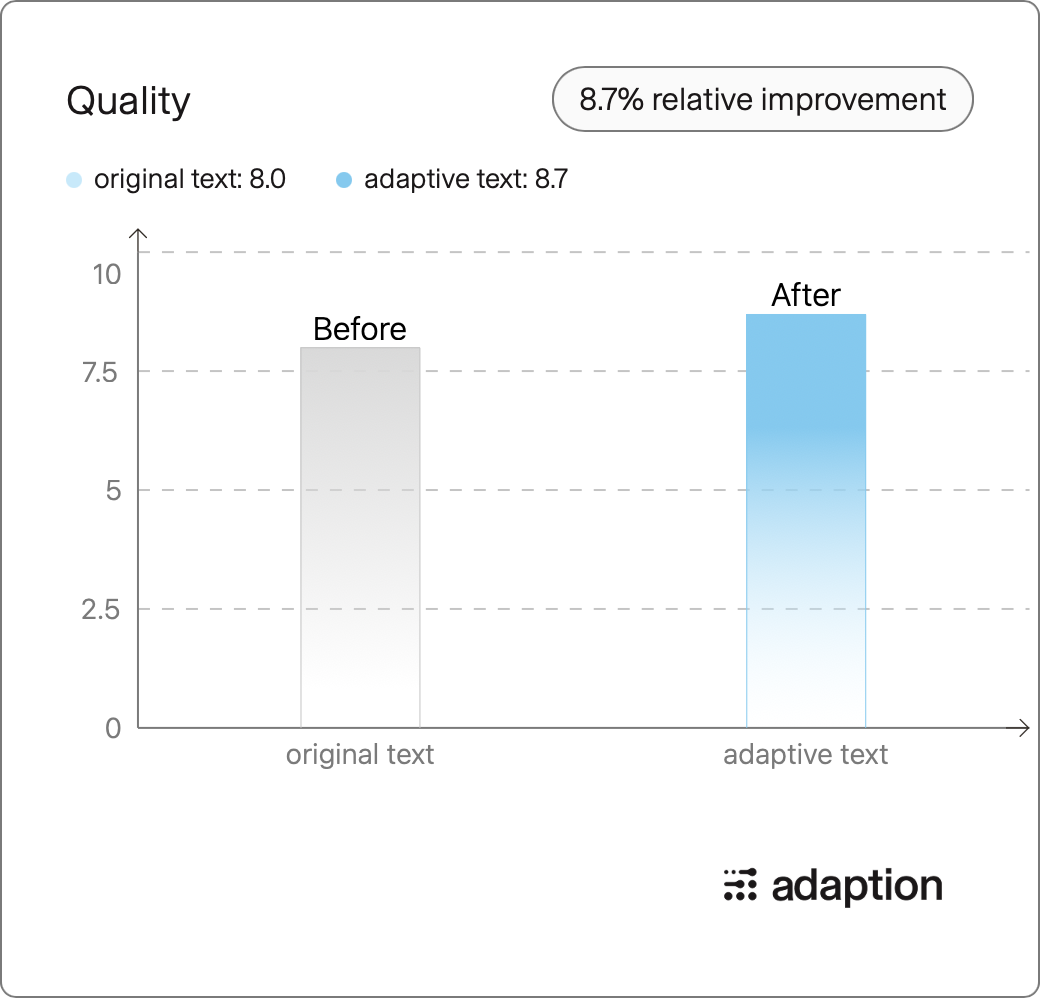
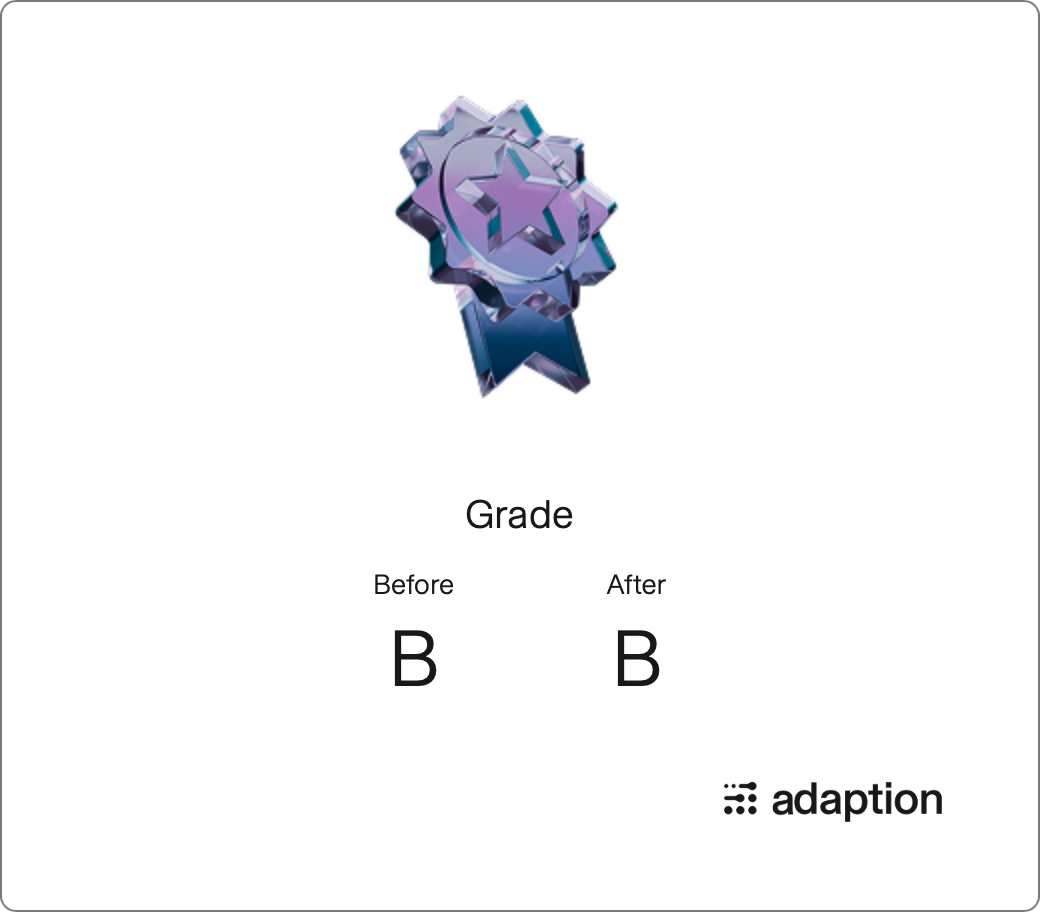
The final quality is B, with a relative quality improvement of 8.7%.
Domain
- Science (22%)
- Math (16%)
- Governance (8%)
Language
- English (100%)
Tone
- Informative (24%)
- Analytical (20%)
- Educational (12%)
Evaluation Results
Quality Gains:
Grade Improvement:
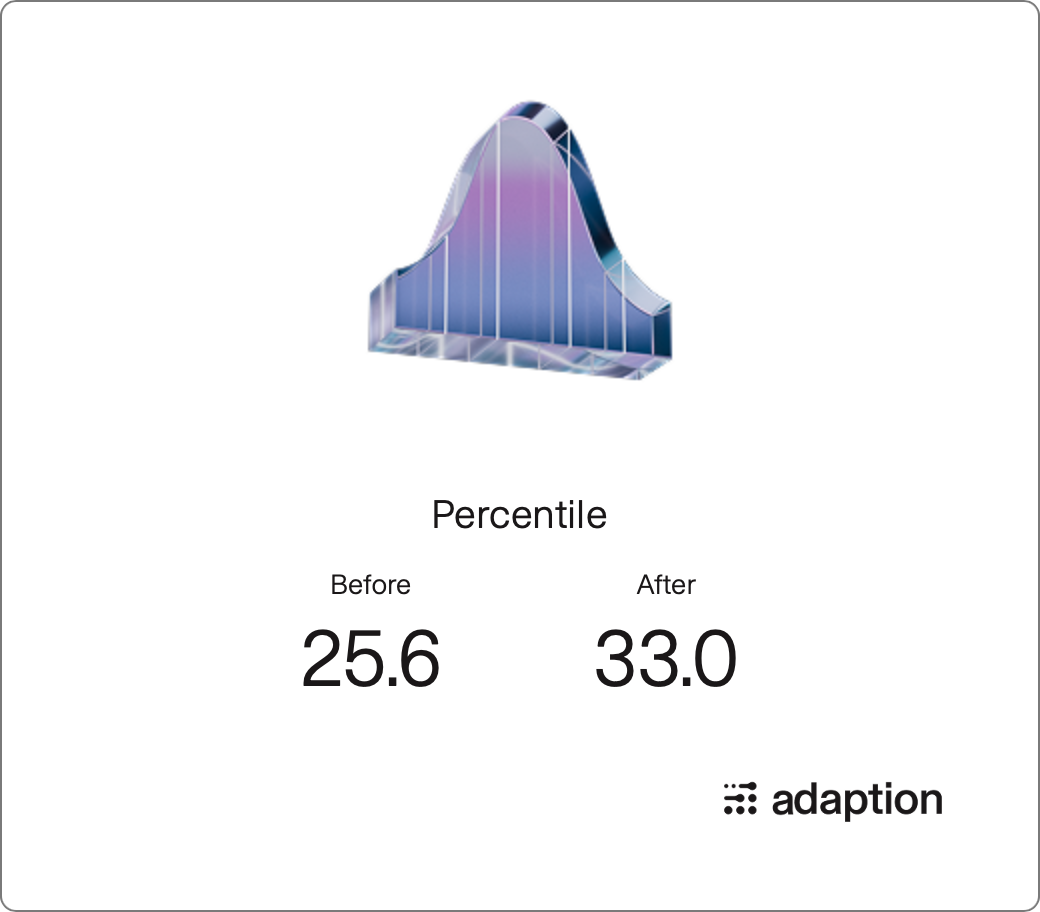
Percentile Chart:
- Downloads last month
- 25