

Nanbeige4.2-3B quants (looped transformer)
Collection
FP8 default, LoopShield 4-bit loop-aware placement, NVFP4A16 speed pick. Gates + failure modes on each card. • 4 items • Updated
FP8 W8A8 (dynamic per-token activations) quantization of
Nanbeige/Nanbeige4.2-3B — the looped
transformer (22 layers × num_loops: 2). 4.9 GB (from 7.9), +60% batch-1 decode, no
measurable quality loss on any gate I ran. This is my recommended serving artifact
for this model.
The looped architecture executes every layer twice per token, which compounds quantization error twice per token. In my gate battery (below), uniform NVFP4 lost 8 points of GSM8K strict; FP8-dynamic lost nothing — its runtime per-token activation scales adapt to each loop pass's distinct activation distribution. As far as I can tell these are the first published FP4/FP8 quantization results for a looped LLM (the only prior looped-LLM PTQ study, LoopQ arXiv:2605.16343, tested INT formats only).
Public harnesses first (lm-eval, reproducible), then my closed harnesses (relative signals within this family). Speed has its own section below.
| bench | mode | bf16 | FP8-Dynamic |
|---|---|---|---|
| GSM8K strict (n=100) | thinking | not measured | 89 |
| GSM8K flexible | thinking | not measured | 93 |
| GPQA-diamond (flexible-extract, n=198, 32k budget) | thinking | not measured | 81.3 |
| IFEval prompt-strict (n=250) | non-thinking | not measured | 76.4 |
| IFEval inst-strict | non-thinking | not measured | 83.5 |
| MMLU-Pro (25/category) | non-thinking | not measured | 62.6 |
| BBH CoT few-shot | non-thinking | not measured | 64.9 |
| MultiHop-RAG (gold evidence, n=248) | non-thinking | not measured | 74.2 |
| Blind-judge summarization (closed, 48 articles, same-judge pair) | non-thinking | 4.61 | 4.55 (noise-level Δ) |
| Judged faithfulness (closed) | non-thinking | 5.0 | 4.95-5.0 |
| Judged fabrication / context leaks (closed) | non-thinking | 0% / 0% | 0-2% / 0% |
| Dictation-rewrite taxonomy (closed, 20 cases) | non-thinking | 18/20 | 18/20 |
Judge protocol: blind single-judge, per-article anonymized+shuffled candidates, strict rubric (faithfulness/coverage/conciseness/coherence/concern-validity).
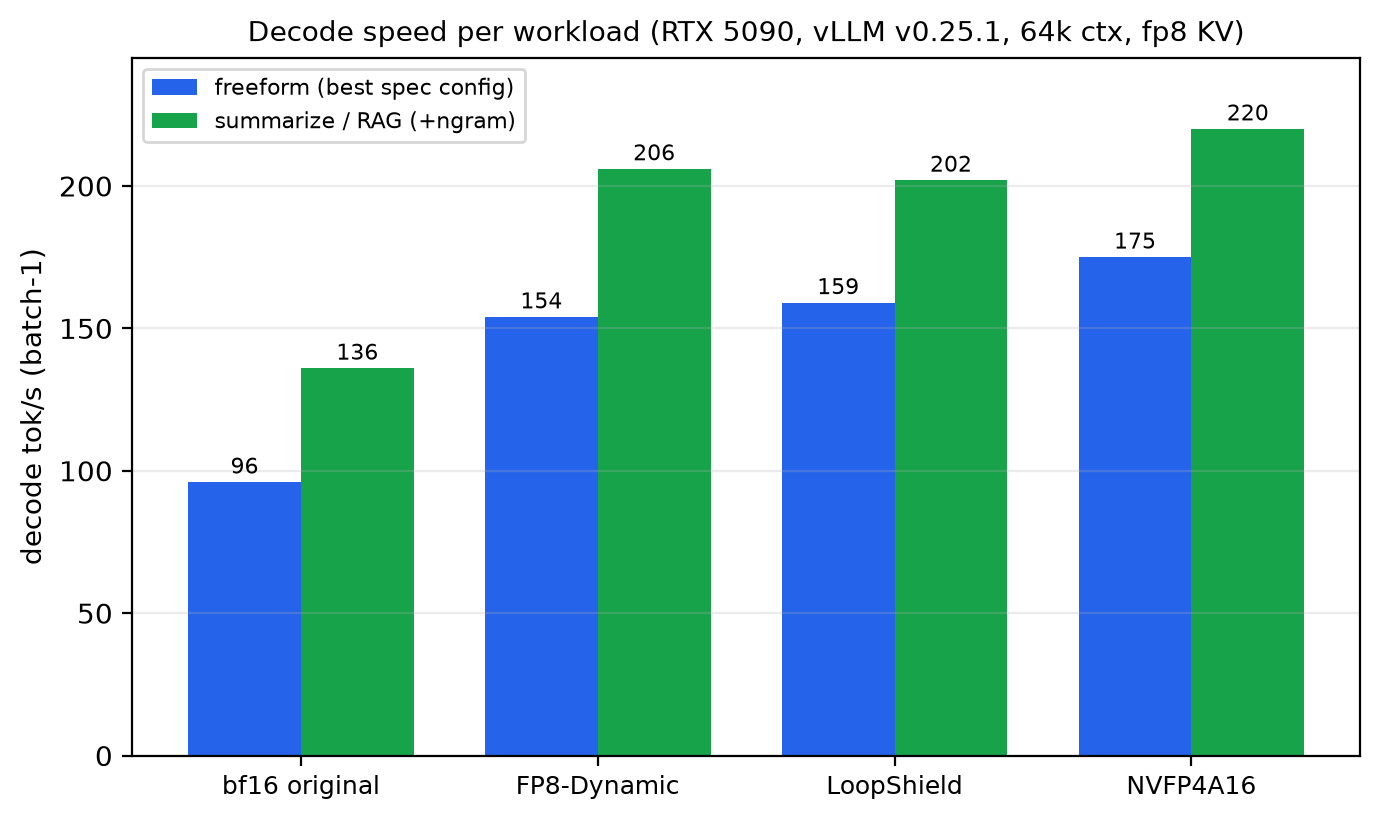
Decode tok/s, single stream, per-workload best speculative config:
| workload | spec decode | bf16 | FP8-Dynamic |
|---|---|---|---|
| freeform / chat / agent | off | 96 | 154 |
| summarize / RAG (2k+ ctx prompts) | ngram, 8 tok | 136 | 206 |
These are two workload anchors, not an ISL sweep; decode speed shifts with context length, batch size, and backend. Notes from the serving campaign:
VLLM_ATTENTION_BACKEND=TRITON_ATTN lifted spec-off short-form decode a
further +13% in my follow-up runs.Concurrency sweep of the production config (FP8 + EAGLE-3 draft, TRITON_ATTN, k=3) on real article prompts. Aggregate throughput scales with concurrency; inter-token latency stays essentially flat under load.

| concurrent streams | aggregate output tok/s | TTFT p50 (ms) | ITL p50 (ms) |
|---|---|---|---|
| 4 | 435 | 56 | 7.7 |
| 8 | 750 | 187 | 8.2 |
| 16 | 993 | 303 | 8.5 |
Measured with GuideLLM on an RTX 5090, vLLM v0.25.1, real multi-kB article prompts. Single-stream decode is the 154-244 tok/s in the Speed table; this shows the same server saturating to ~1000 tok/s aggregate at concurrency 16 with per-token latency near-constant, i.e. it batches well for multi-user / parallel-agent workloads. Spec acceptance held over the run (165k accepted / 502k drafted).
The architecture is not yet in upstream vLLM (PR #49433 open). Until it merges, install the bundled out-of-tree plugin (vendored from that PR), then serve normally — the checkpoint format is auto-detected:
pip install --no-deps ./vllm_plugin
VLLM_ATTENTION_BACKEND=TRITON_ATTN \
vllm serve <this-repo> --trust-remote-code \
  --max-model-len 65536 --kv-cache-dtype fp8 \
  --reasoning-parser qwen3 --enable-auto-tool-choice --tool-call-parser qwen3_xml \
  --speculative-config '{"method":"eagle3","model":"NullSense/Nanbeige4.2-3B-EAGLE3","num_speculative_tokens":3}'
Since 2026-07-23 the recommended speculation is my
EAGLE-3 draft head:
221 freeform / 244 short-passage summarize / 262 code tok/s in one config
(TRITON_ATTN required with it; FlashInfer + spec drops CUDA graphs to piecewise on
SM120). One measured exception: LONG-document summarization (multi-k-char inputs)
still favors the ngram config ({"method":"ngram","num_speculative_tokens":8, "prompt_lookup_max":4,"prompt_lookup_min":2}): 231 vs 160 output tok/s on 16 real
articles; verbatim copy-spans reward lookup drafting. Pick per dominant workload.
chat_template_kwargs: {"enable_thinking": false}
(+ preserve_thinking: false for chat) to disable. Sampling defaults
(T=0.6/top_p=0.95/top_k=20) ship in generation_config.json; use T=1.0 for agentic.--speculative-config for freeform-heavy serving.--kv-cache-dtype nvfp4 is SM100-only; use fp8 on consumer Blackwell.Download just this artifact:
hf download NullSense/Nanbeige4.2-3B-FP8-Dynamic --local-dir Nanbeige4.2-3B-FP8-Dynamic
llmcompressor QuantizationModifier(targets="Linear", scheme="FP8_DYNAMIC", ignore=["lm_head"]), data-free oneshot(). transformers ≥5 users: the bundled
modeling_nanbeige.py includes two one-line compat patches vs the original repo
(rope_scaling "type" key, _tied_weights_keys list→dict) — required for any
transformers-5 loading (llmcompressor, finetuning); vLLM serving does not use them.


| artifact | size | tok/s (freeform / summ) | pick when |
|---|---|---|---|
| FP8-Dynamic (this repo) | 4.9 GB | 154 / 206 | default: no measured quality loss on any gate. Recommended. |
| NVFP4-FP8-LoopShield | 4.5 GB | 159 / 202 | smallest artifact that keeps reasoning at FP8 parity; best JSON reliability. Recommended for tight VRAM. |
| NVFP4A16 | 3.6 GB | 175 / 220 | fastest; summarization/extraction only (reasoning drops 8 GSM8K points). Not for math/agentic. |
| EAGLE3 draft | +1.5 GB | 221 / 244 (262 code) | add-on speculator for any of the above: +33-58% decode, lossless. Serve with TRITON_ATTN. |
All three serve identically (same plugin, same flags); only the checkpoint differs. Rule of thumb: this model + 64k fp8-KV context fits in ~7 GB VRAM at FP8, ~6 GB at NVFP4A16; any 8 GB card runs the full family.
| metric | bf16 original | FP8 (this repo) |
|---|---|---|
| rewrite taxonomy (/20, non-think) | 18 | 18 |
| blind-judge summarization (same judging pass) | 4.61 | 4.55 (noise-level delta) |
| JSON parse rate (/48) | 44 | 42 |
| GSM8K, IFEval, MMLU-Pro, BBH, MultiHop-RAG | not measured on bf16 | measured (tables above) |
Where bf16 was measured, FP8 shows no regression; that is why FP8 serves as the reference for the rest of the family instead of re-running every gate on bf16. The vendor's published numbers are a different suite entirely (agentic/frontier benches, thinking mode at a 131k token budget) and don't map onto these rows — see Benchmark provenance below.
vllm_plugin/ registers it out-of-tree)Public, reproducible (lm-eval-harness local-chat-completions, exact configs in each row's annotation):
Closed/personal harnesses (not publicly reproducible — my own serving-workload gates; treat as relative signals between artifacts in THIS family, not cross-model scores):
@misc{peciukonis2026nanbeige42fp8,
  author       = {Pe{\v{c}}iukonis, Matas (NullSense)},
  title        = {Nanbeige4.2-3B quantization family: loop-aware FP8 and NVFP4 quants of a looped transformer},
  year         = {2026},
  howpublished = {Hugging Face},
  url          = {https://huggingface.co/NullSense/Nanbeige4.2-3B-FP8-Dynamic},
  note         = {First published classic-bench (GSM8K/IFEval/MMLU-Pro/BBH) numbers for this model; no measured regression vs bf16 on any gate run.}
}