Get trending papers in your email inbox once a day!
Get trending papers in your email inbox!
SubscribeThe Geometry of Tokens in Internal Representations of Large Language Models
We investigate the relationship between the geometry of token embeddings and their role in the next token prediction within transformer models. An important aspect of this connection uses the notion of empirical measure, which encodes the distribution of token point clouds across transformer layers and drives the evolution of token representations in the mean-field interacting picture. We use metrics such as intrinsic dimension, neighborhood overlap, and cosine similarity to observationally probe these empirical measures across layers. To validate our approach, we compare these metrics to a dataset where the tokens are shuffled, which disrupts the syntactic and semantic structure. Our findings reveal a correlation between the geometric properties of token embeddings and the cross-entropy loss of next token predictions, implying that prompts with higher loss values have tokens represented in higher-dimensional spaces.
Adversarial Manipulation of Reasoning Models using Internal Representations
Reasoning models generate chain-of-thought (CoT) tokens before their final output, but how this affects their vulnerability to jailbreak attacks remains unclear. While traditional language models make refusal decisions at the prompt-response boundary, we find evidence that DeepSeek-R1-Distill-Llama-8B makes these decisions within its CoT generation. We identify a linear direction in activation space during CoT token generation that predicts whether the model will refuse or comply -- termed the "caution" direction because it corresponds to cautious reasoning patterns in the generated text. Ablating this direction from model activations increases harmful compliance, effectively jailbreaking the model. We additionally show that intervening only on CoT token activations suffices to control final outputs, and that incorporating this direction into prompt-based attacks improves success rates. Our findings suggest that the chain-of-thought itself is a promising new target for adversarial manipulation in reasoning models. Code available at https://github.com/ky295/reasoning-manipulation
Correctness Assessment of Code Generated by Large Language Models Using Internal Representations
Ensuring the correctness of code generated by Large Language Models (LLMs) presents a significant challenge in AI-driven software development. Existing approaches predominantly rely on black-box (closed-box) approaches that evaluate correctness post-generation, failing to utilize the rich insights embedded in the LLMs' internal states during code generation. In this paper, we introduce OPENIA, a novel white-box (open-box) framework that leverages these internal representations to assess the correctness of LLM-generated code. OPENIA systematically analyzes the intermediate states of representative open-source LLMs specialized for code, including DeepSeek-Coder, CodeLlama, and MagicCoder, across diverse code generation benchmarks. Our empirical analysis reveals that these internal representations encode latent information, which strongly correlates with the correctness of the generated code. Building on these insights, OPENIA uses a white-box/open-box approach to make informed predictions about code correctness, offering significant advantages in adaptability and robustness over traditional classification-based methods and zero-shot approaches. Experimental results demonstrate that OPENIA consistently outperforms baseline models, achieving higher accuracy, precision, recall, and F1-Scores with up to a 2X improvement in standalone code generation and a 46% enhancement in repository-specific scenarios. By unlocking the potential of in-process signals, OPENIA paves the way for more proactive and efficient quality assurance mechanisms in LLM-assisted code generation.
Analyzing LLMs' Knowledge Boundary Cognition Across Languages Through the Lens of Internal Representations
While understanding the knowledge boundaries of LLMs is crucial to prevent hallucination, research on knowledge boundaries of LLMs has predominantly focused on English. In this work, we present the first study to analyze how LLMs recognize knowledge boundaries across different languages by probing their internal representations when processing known and unknown questions in multiple languages. Our empirical studies reveal three key findings: 1) LLMs' perceptions of knowledge boundaries are encoded in the middle to middle-upper layers across different languages. 2) Language differences in knowledge boundary perception follow a linear structure, which motivates our proposal of a training-free alignment method that effectively transfers knowledge boundary perception ability across languages, thereby helping reduce hallucination risk in low-resource languages; 3) Fine-tuning on bilingual question pair translation further enhances LLMs' recognition of knowledge boundaries across languages. Given the absence of standard testbeds for cross-lingual knowledge boundary analysis, we construct a multilingual evaluation suite comprising three representative types of knowledge boundary data. Our code and datasets are publicly available at https://github.com/DAMO-NLP-SG/LLM-Multilingual-Knowledge-Boundaries.
Cognitive Dissonance: Why Do Language Model Outputs Disagree with Internal Representations of Truthfulness?
Neural language models (LMs) can be used to evaluate the truth of factual statements in two ways: they can be either queried for statement probabilities, or probed for internal representations of truthfulness. Past work has found that these two procedures sometimes disagree, and that probes tend to be more accurate than LM outputs. This has led some researchers to conclude that LMs "lie" or otherwise encode non-cooperative communicative intents. Is this an accurate description of today's LMs, or can query-probe disagreement arise in other ways? We identify three different classes of disagreement, which we term confabulation, deception, and heterogeneity. In many cases, the superiority of probes is simply attributable to better calibration on uncertain answers rather than a greater fraction of correct, high-confidence answers. In some cases, queries and probes perform better on different subsets of inputs, and accuracy can further be improved by ensembling the two. Code is available at github.com/lingo-mit/lm-truthfulness.
Interpreting and Editing Vision-Language Representations to Mitigate Hallucinations
We investigate the internal representations of vision-language models (VLMs) to address hallucinations, a persistent challenge despite advances in model size and training. We project VLMs' internal image representations to their language vocabulary and observe more confident output probabilities on real objects than hallucinated objects. We additionally use these output probabilities to spatially localize real objects. Building on this approach, we introduce a knowledge erasure algorithm that removes hallucinations by linearly orthogonalizing image features with respect to hallucinated object features. We show that targeted edits to a model's latent representations can reduce hallucinations by up to 25.7% on the COCO2014 dataset while preserving performance. Our findings demonstrate how a deeper understanding of VLMs' latent representations can enhance reliability and enable novel capabilities, such as zero-shot segmentation.
Emergent Linear Representations in World Models of Self-Supervised Sequence Models
How do sequence models represent their decision-making process? Prior work suggests that Othello-playing neural network learned nonlinear models of the board state (Li et al., 2023). In this work, we provide evidence of a closely related linear representation of the board. In particular, we show that probing for "my colour" vs. "opponent's colour" may be a simple yet powerful way to interpret the model's internal state. This precise understanding of the internal representations allows us to control the model's behaviour with simple vector arithmetic. Linear representations enable significant interpretability progress, which we demonstrate with further exploration of how the world model is computed.
AdaptiveK Sparse Autoencoders: Dynamic Sparsity Allocation for Interpretable LLM Representations
Understanding the internal representations of large language models (LLMs) remains a central challenge for interpretability research. Sparse autoencoders (SAEs) offer a promising solution by decomposing activations into interpretable features, but existing approaches rely on fixed sparsity constraints that fail to account for input complexity. We propose Adaptive Top K Sparse Autoencoders (AdaptiveK), a novel framework that dynamically adjusts sparsity levels based on the semantic complexity of each input. Leveraging linear probes, we demonstrate that context complexity is linearly encoded in LLM representations, and we use this signal to guide feature allocation during training. Experiments across three language models (Pythia-70M, Pythia-160M, and Gemma-2-2B) demonstrate that this complexity-driven adaptation significantly outperforms fixed-sparsity approaches on reconstruction fidelity, explained variance, and cosine similarity metrics while eliminating the computational burden of extensive hyperparameter tuning.
Structured World Representations in Maze-Solving Transformers
Transformer models underpin many recent advances in practical machine learning applications, yet understanding their internal behavior continues to elude researchers. Given the size and complexity of these models, forming a comprehensive picture of their inner workings remains a significant challenge. To this end, we set out to understand small transformer models in a more tractable setting: that of solving mazes. In this work, we focus on the abstractions formed by these models and find evidence for the consistent emergence of structured internal representations of maze topology and valid paths. We demonstrate this by showing that the residual stream of only a single token can be linearly decoded to faithfully reconstruct the entire maze. We also find that the learned embeddings of individual tokens have spatial structure. Furthermore, we take steps towards deciphering the circuity of path-following by identifying attention heads (dubbed adjacency heads), which are implicated in finding valid subsequent tokens.
Emergent representations in networks trained with the Forward-Forward algorithm
The Backpropagation algorithm, widely used to train neural networks, has often been criticised for its lack of biological realism. In an attempt to find a more biologically plausible alternative, and avoid to back-propagate gradients in favour of using local learning rules, the recently introduced Forward-Forward algorithm replaces the traditional forward and backward passes of Backpropagation with two forward passes. In this work, we show that internal representations obtained with the Forward-Forward algorithm organize into robust, category-specific ensembles, composed by an extremely low number of active units (high sparsity). This is remarkably similar to what is observed in cortical representations during sensory processing. While not found in models trained with standard Backpropagation, sparsity emerges also in networks optimized by Backpropagation, on the same training objective of Forward-Forward. These results suggest that the learning procedure proposed by Forward-Forward may be superior to Backpropagation in modelling learning in the cortex, even when a backward pass is used.
Benchmarking Mental State Representations in Language Models
While numerous works have assessed the generative performance of language models (LMs) on tasks requiring Theory of Mind reasoning, research into the models' internal representation of mental states remains limited. Recent work has used probing to demonstrate that LMs can represent beliefs of themselves and others. However, these claims are accompanied by limited evaluation, making it difficult to assess how mental state representations are affected by model design and training choices. We report an extensive benchmark with various LM types with different model sizes, fine-tuning approaches, and prompt designs to study the robustness of mental state representations and memorisation issues within the probes. Our results show that the quality of models' internal representations of the beliefs of others increases with model size and, more crucially, with fine-tuning. We are the first to study how prompt variations impact probing performance on theory of mind tasks. We demonstrate that models' representations are sensitive to prompt variations, even when such variations should be beneficial. Finally, we complement previous activation editing experiments on Theory of Mind tasks and show that it is possible to improve models' reasoning performance by steering their activations without the need to train any probe.
Word class representations spontaneously emerge in a deep neural network trained on next word prediction
How do humans learn language, and can the first language be learned at all? These fundamental questions are still hotly debated. In contemporary linguistics, there are two major schools of thought that give completely opposite answers. According to Chomsky's theory of universal grammar, language cannot be learned because children are not exposed to sufficient data in their linguistic environment. In contrast, usage-based models of language assume a profound relationship between language structure and language use. In particular, contextual mental processing and mental representations are assumed to have the cognitive capacity to capture the complexity of actual language use at all levels. The prime example is syntax, i.e., the rules by which words are assembled into larger units such as sentences. Typically, syntactic rules are expressed as sequences of word classes. However, it remains unclear whether word classes are innate, as implied by universal grammar, or whether they emerge during language acquisition, as suggested by usage-based approaches. Here, we address this issue from a machine learning and natural language processing perspective. In particular, we trained an artificial deep neural network on predicting the next word, provided sequences of consecutive words as input. Subsequently, we analyzed the emerging activation patterns in the hidden layers of the neural network. Strikingly, we find that the internal representations of nine-word input sequences cluster according to the word class of the tenth word to be predicted as output, even though the neural network did not receive any explicit information about syntactic rules or word classes during training. This surprising result suggests, that also in the human brain, abstract representational categories such as word classes may naturally emerge as a consequence of predictive coding and processing during language acquisition.
Patchscope: A Unifying Framework for Inspecting Hidden Representations of Language Models
Inspecting the information encoded in hidden representations of large language models (LLMs) can explain models' behavior and verify their alignment with human values. Given the capabilities of LLMs in generating human-understandable text, we propose leveraging the model itself to explain its internal representations in natural language. We introduce a framework called Patchscopes and show how it can be used to answer a wide range of research questions about an LLM's computation. We show that prior interpretability methods based on projecting representations into the vocabulary space and intervening on the LLM computation, can be viewed as special instances of this framework. Moreover, several of their shortcomings such as failure in inspecting early layers or lack of expressivity can be mitigated by a Patchscope. Beyond unifying prior inspection techniques, Patchscopes also opens up new possibilities such as using a more capable model to explain the representations of a smaller model, and unlocks new applications such as self-correction in multi-hop reasoning.
Droplets of Good Representations: Grokking as a First Order Phase Transition in Two Layer Networks
A key property of deep neural networks (DNNs) is their ability to learn new features during training. This intriguing aspect of deep learning stands out most clearly in recently reported Grokking phenomena. While mainly reflected as a sudden increase in test accuracy, Grokking is also believed to be a beyond lazy-learning/Gaussian Process (GP) phenomenon involving feature learning. Here we apply a recent development in the theory of feature learning, the adaptive kernel approach, to two teacher-student models with cubic-polynomial and modular addition teachers. We provide analytical predictions on feature learning and Grokking properties of these models and demonstrate a mapping between Grokking and the theory of phase transitions. We show that after Grokking, the state of the DNN is analogous to the mixed phase following a first-order phase transition. In this mixed phase, the DNN generates useful internal representations of the teacher that are sharply distinct from those before the transition.
Emergent World Representations: Exploring a Sequence Model Trained on a Synthetic Task
Language models show a surprising range of capabilities, but the source of their apparent competence is unclear. Do these networks just memorize a collection of surface statistics, or do they rely on internal representations of the process that generates the sequences they see? We investigate this question by applying a variant of the GPT model to the task of predicting legal moves in a simple board game, Othello. Although the network has no a priori knowledge of the game or its rules, we uncover evidence of an emergent nonlinear internal representation of the board state. Interventional experiments indicate this representation can be used to control the output of the network and create "latent saliency maps" that can help explain predictions in human terms.
Hyperdimensional Probe: Decoding LLM Representations via Vector Symbolic Architectures
Despite their capabilities, Large Language Models (LLMs) remain opaque with limited understanding of their internal representations. Current interpretability methods, such as direct logit attribution (DLA) and sparse autoencoders (SAEs), provide restricted insight due to limitations such as the model's output vocabulary or unclear feature names. This work introduces Hyperdimensional Probe, a novel paradigm for decoding information from the LLM vector space. It combines ideas from symbolic representations and neural probing to project the model's residual stream into interpretable concepts via Vector Symbolic Architectures (VSAs). This probe combines the strengths of SAEs and conventional probes while overcoming their key limitations. We validate our decoding paradigm with controlled input-completion tasks, probing the model's final state before next-token prediction on inputs spanning syntactic pattern recognition, key-value associations, and abstract inference. We further assess it in a question-answering setting, examining the state of the model both before and after text generation. Our experiments show that our probe reliably extracts meaningful concepts across varied LLMs, embedding sizes, and input domains, also helping identify LLM failures. Our work advances information decoding in LLM vector space, enabling extracting more informative, interpretable, and structured features from neural representations.
Learned feature representations are biased by complexity, learning order, position, and more
Representation learning, and interpreting learned representations, are key areas of focus in machine learning and neuroscience. Both fields generally use representations as a means to understand or improve a system's computations. In this work, however, we explore surprising dissociations between representation and computation that may pose challenges for such efforts. We create datasets in which we attempt to match the computational role that different features play, while manipulating other properties of the features or the data. We train various deep learning architectures to compute these multiple abstract features about their inputs. We find that their learned feature representations are systematically biased towards representing some features more strongly than others, depending upon extraneous properties such as feature complexity, the order in which features are learned, and the distribution of features over the inputs. For example, features that are simpler to compute or learned first tend to be represented more strongly and densely than features that are more complex or learned later, even if all features are learned equally well. We also explore how these biases are affected by architectures, optimizers, and training regimes (e.g., in transformers, features decoded earlier in the output sequence also tend to be represented more strongly). Our results help to characterize the inductive biases of gradient-based representation learning. These results also highlight a key challenge for interpretability - or for comparing the representations of models and brains - disentangling extraneous biases from the computationally important aspects of a system's internal representations.
Calibrating Reasoning in Language Models with Internal Consistency
Large language models (LLMs) have demonstrated impressive capabilities in various reasoning tasks, aided by techniques like chain-of-thought (CoT) prompting that elicits verbalized reasoning. However, LLMs often generate text with obvious mistakes and contradictions, raising doubts about their ability to robustly process and utilize generated rationales. In this work, we investigate CoT reasoning in LLMs through the lens of internal representations, focusing on how these representations are influenced by generated rationales. Our preliminary analysis reveals that while generated rationales improve answer accuracy, inconsistencies emerge between the model's internal representations in middle layers and those in final layers, potentially undermining the reliability of their reasoning processes. To address this, we propose internal consistency as a measure of the model's confidence by examining the agreement of latent predictions decoded from intermediate layers. Extensive empirical studies across different models and datasets demonstrate that internal consistency effectively distinguishes between correct and incorrect reasoning paths. Motivated by this, we propose a new approach to calibrate CoT reasoning by up-weighting reasoning paths with high internal consistency, resulting in a significant boost in reasoning performance. Further analysis uncovers distinct patterns in attention and feed-forward modules across layers, providing insights into the emergence of internal inconsistency. In summary, our results demonstrate the potential of using internal representations for self-evaluation of LLMs.
How do Multimodal Foundation Models Encode Text and Speech? An Analysis of Cross-Lingual and Cross-Modal Representations
Multimodal foundation models aim to create a unified representation space that abstracts away from surface features like language syntax or modality differences. To investigate this, we study the internal representations of three recent models, analyzing the model activations from semantically equivalent sentences across languages in the text and speech modalities. Our findings reveal that: 1) Cross-modal representations converge over model layers, except in the initial layers specialized at text and speech processing. 2) Length adaptation is crucial for reducing the cross-modal gap between text and speech, although current approaches' effectiveness is primarily limited to high-resource languages. 3) Speech exhibits larger cross-lingual differences than text. 4) For models not explicitly trained for modality-agnostic representations, the modality gap is more prominent than the language gap.
Language Mixing in Reasoning Language Models: Patterns, Impact, and Internal Causes
Reasoning language models (RLMs) excel at complex tasks by leveraging a chain-of-thought process to generate structured intermediate steps. However, language mixing, i.e., reasoning steps containing tokens from languages other than the prompt, has been observed in their outputs and shown to affect performance, though its impact remains debated. We present the first systematic study of language mixing in RLMs, examining its patterns, impact, and internal causes across 15 languages, 7 task difficulty levels, and 18 subject areas, and show how all three factors influence language mixing. Moreover, we demonstrate that the choice of reasoning language significantly affects performance: forcing models to reason in Latin or Han scripts via constrained decoding notably improves accuracy. Finally, we show that the script composition of reasoning traces closely aligns with that of the model's internal representations, indicating that language mixing reflects latent processing preferences in RLMs. Our findings provide actionable insights for optimizing multilingual reasoning and open new directions for controlling reasoning languages to build more interpretable and adaptable RLMs.
NER Retriever: Zero-Shot Named Entity Retrieval with Type-Aware Embeddings
We present NER Retriever, a zero-shot retrieval framework for ad-hoc Named Entity Retrieval, a variant of Named Entity Recognition (NER), where the types of interest are not provided in advance, and a user-defined type description is used to retrieve documents mentioning entities of that type. Instead of relying on fixed schemas or fine-tuned models, our method builds on internal representations of large language models (LLMs) to embed both entity mentions and user-provided open-ended type descriptions into a shared semantic space. We show that internal representations, specifically the value vectors from mid-layer transformer blocks, encode fine-grained type information more effectively than commonly used top-layer embeddings. To refine these representations, we train a lightweight contrastive projection network that aligns type-compatible entities while separating unrelated types. The resulting entity embeddings are compact, type-aware, and well-suited for nearest-neighbor search. Evaluated on three benchmarks, NER Retriever significantly outperforms both lexical and dense sentence-level retrieval baselines. Our findings provide empirical support for representation selection within LLMs and demonstrate a practical solution for scalable, schema-free entity retrieval. The NER Retriever Codebase is publicly available at https://github.com/ShacharOr100/ner_retriever
Continuous Thought Machines
Biological brains demonstrate complex neural activity, where the timing and interplay between neurons is critical to how brains process information. Most deep learning architectures simplify neural activity by abstracting away temporal dynamics. In this paper we challenge that paradigm. By incorporating neuron-level processing and synchronization, we can effectively reintroduce neural timing as a foundational element. We present the Continuous Thought Machine (CTM), a model designed to leverage neural dynamics as its core representation. The CTM has two core innovations: (1) neuron-level temporal processing, where each neuron uses unique weight parameters to process a history of incoming signals; and (2) neural synchronization employed as a latent representation. The CTM aims to strike a balance between oversimplified neuron abstractions that improve computational efficiency, and biological realism. It operates at a level of abstraction that effectively captures essential temporal dynamics while remaining computationally tractable for deep learning. We demonstrate the CTM's strong performance and versatility across a range of challenging tasks, including ImageNet-1K classification, solving 2D mazes, sorting, parity computation, question-answering, and RL tasks. Beyond displaying rich internal representations and offering a natural avenue for interpretation owing to its internal process, the CTM is able to perform tasks that require complex sequential reasoning. The CTM can also leverage adaptive compute, where it can stop earlier for simpler tasks, or keep computing when faced with more challenging instances. The goal of this work is to share the CTM and its associated innovations, rather than pushing for new state-of-the-art results. To that end, we believe the CTM represents a significant step toward developing more biologically plausible and powerful artificial intelligence systems.
RECALL: REpresentation-aligned Catastrophic-forgetting ALLeviation via Hierarchical Model Merging
We unveil that internal representations in large language models (LLMs) serve as reliable proxies of learned knowledge, and propose RECALL, a novel representation-aware model merging framework for continual learning without access to historical data. RECALL computes inter-model similarity from layer-wise hidden representations over clustered typical samples, and performs adaptive, hierarchical parameter fusion to align knowledge across models. This design enables the preservation of domain-general features in shallow layers while allowing task-specific adaptation in deeper layers. Unlike prior methods that require task labels or incur performance trade-offs, RECALL achieves seamless multi-domain integration and strong resistance to catastrophic forgetting. Extensive experiments across five NLP tasks and multiple continual learning scenarios show that RECALL outperforms baselines in both knowledge retention and generalization, providing a scalable and data-free solution for evolving LLMs.
Task Vectors are Cross-Modal
We investigate the internal representations of vision-and-language models (VLMs) and how they encode task representations. We consider tasks specified through examples or instructions, using either text or image inputs. Surprisingly, we find that conceptually similar tasks are mapped to similar task vector representations, regardless of how they are specified. Our findings suggest that to output answers, tokens in VLMs undergo three distinct phases: input, task, and answer, a process which is consistent across different modalities and specifications. The task vectors we identify in VLMs are general enough to be derived in one modality (e.g., text) and transferred to another (e.g., image). Additionally, we find that ensembling exemplar and instruction based task vectors produce better task representations. Taken together, these insights shed light on the underlying mechanisms of VLMs, particularly their ability to represent tasks in a shared manner across different modalities and task specifications. Project page: https://task-vectors-are-cross-modal.github.io.
OMNIGUARD: An Efficient Approach for AI Safety Moderation Across Modalities
The emerging capabilities of large language models (LLMs) have sparked concerns about their immediate potential for harmful misuse. The core approach to mitigate these concerns is the detection of harmful queries to the model. Current detection approaches are fallible, and are particularly susceptible to attacks that exploit mismatched generalization of model capabilities (e.g., prompts in low-resource languages or prompts provided in non-text modalities such as image and audio). To tackle this challenge, we propose OMNIGUARD, an approach for detecting harmful prompts across languages and modalities. Our approach (i) identifies internal representations of an LLM/MLLM that are aligned across languages or modalities and then (ii) uses them to build a language-agnostic or modality-agnostic classifier for detecting harmful prompts. OMNIGUARD improves harmful prompt classification accuracy by 11.57\% over the strongest baseline in a multilingual setting, by 20.44\% for image-based prompts, and sets a new SOTA for audio-based prompts. By repurposing embeddings computed during generation, OMNIGUARD is also very efficient (approx 120 times faster than the next fastest baseline). Code and data are available at: https://github.com/vsahil/OmniGuard.
LENS: Learning Ensemble Confidence from Neural States for Multi-LLM Answer Integration
Large Language Models (LLMs) have demonstrated impressive performance across various tasks, with different models excelling in distinct domains and specific abilities. Effectively combining the predictions of multiple LLMs is crucial for enhancing system robustness and performance. However, existing ensemble methods often rely on simple techniques like voting or logits ensembling, which overlook the varying confidence and reliability of models in different contexts. In this work, we propose LENS (Learning ENsemble confidence from Neural States), a novel approach that learns to estimate model confidence by analyzing internal representations. For each LLM, we train a lightweight linear confidence predictor that leverages layer-wise hidden states and normalized probabilities as inputs. This allows for more nuanced weighting of model predictions based on their context-dependent reliability. Our method does not require modifying the model parameters and requires negligible additional computation. Experimental results on multiple-choice and boolean question-answering tasks demonstrate that LENS outperforms traditional ensemble methods by a substantial margin. Our findings suggest that internal representations provide valuable signals for determining model confidence and can be effectively leveraged for ensemble learning.
FactCheckmate: Preemptively Detecting and Mitigating Hallucinations in LMs
Language models (LMs) hallucinate. We inquire: Can we detect and mitigate hallucinations before they happen? This work answers this research question in the positive, by showing that the internal representations of LMs provide rich signals that can be used for this purpose. We introduce FactCheckMate, which preemptively detects hallucinations by learning a classifier that predicts whether the LM will hallucinate, based on the model's hidden states produced over the inputs, before decoding begins. If a hallucination is detected, FactCheckMate then intervenes, by adjusting the LM's hidden states such that the model will produce more factual outputs. FactCheckMate provides fresh insights that the inner workings of LMs can be revealed by their hidden states. Practically, both the detection and mitigation models in FactCheckMate are lightweight, adding little inference overhead; FactCheckMate proves a more efficient approach for mitigating hallucinations compared to many post-hoc alternatives. We evaluate FactCheckMate over LMs of different scales and model families (including Llama, Mistral, and Gemma), across a variety of QA datasets from different domains. Our results demonstrate the effectiveness of leveraging internal representations for early hallucination detection and mitigation, achieving over 70% preemptive detection accuracy. On average, outputs generated by LMs with intervention are 34.4% more factual compared to those without intervention. The average overhead difference in the inference time introduced by FactCheckMate is around 3.16 seconds.
Open-Vocabulary Panoptic Segmentation with Text-to-Image Diffusion Models
We present ODISE: Open-vocabulary DIffusion-based panoptic SEgmentation, which unifies pre-trained text-image diffusion and discriminative models to perform open-vocabulary panoptic segmentation. Text-to-image diffusion models have the remarkable ability to generate high-quality images with diverse open-vocabulary language descriptions. This demonstrates that their internal representation space is highly correlated with open concepts in the real world. Text-image discriminative models like CLIP, on the other hand, are good at classifying images into open-vocabulary labels. We leverage the frozen internal representations of both these models to perform panoptic segmentation of any category in the wild. Our approach outperforms the previous state of the art by significant margins on both open-vocabulary panoptic and semantic segmentation tasks. In particular, with COCO training only, our method achieves 23.4 PQ and 30.0 mIoU on the ADE20K dataset, with 8.3 PQ and 7.9 mIoU absolute improvement over the previous state of the art. We open-source our code and models at https://github.com/NVlabs/ODISE .
Time-Aware Feature Selection: Adaptive Temporal Masking for Stable Sparse Autoencoder Training
Understanding the internal representations of large language models is crucial for ensuring their reliability and safety, with sparse autoencoders (SAEs) emerging as a promising interpretability approach. However, current SAE training methods face feature absorption, where features (or neurons) are absorbed into each other to minimize L_1 penalty, making it difficult to consistently identify and analyze model behaviors. We introduce Adaptive Temporal Masking (ATM), a novel training approach that dynamically adjusts feature selection by tracking activation magnitudes, frequencies, and reconstruction contributions to compute importance scores that evolve over time. ATM applies a probabilistic masking mechanism based on statistical thresholding of these importance scores, creating a more natural feature selection process. Through extensive experiments on the Gemma-2-2b model, we demonstrate that ATM achieves substantially lower absorption scores compared to existing methods like TopK and JumpReLU SAEs, while maintaining excellent reconstruction quality. These results establish ATM as a principled solution for learning stable, interpretable features in neural networks, providing a foundation for more reliable model analysis.
Towards Atoms of Large Language Models
The fundamental units of internal representations in large language models (LLMs) remain undefined, limiting further understanding of their mechanisms. Neurons or features are often regarded as such units, yet neurons suffer from polysemy, while features face concerns of unreliable reconstruction and instability. To address this issue, we propose the Atoms Theory, which defines such units as atoms. We introduce the atomic inner product (AIP) to correct representation shifting, formally define atoms, and prove the conditions that atoms satisfy the Restricted Isometry Property (RIP), ensuring stable sparse representations over atom set and linking to compressed sensing. Under stronger conditions, we further establish the uniqueness and exact ell_1 recoverability of the sparse representations, and provide guarantees that single-layer sparse autoencoders (SAEs) with threshold activations can reliably identify the atoms. To validate the Atoms Theory, we train threshold-activated SAEs on Gemma2-2B, Gemma2-9B, and Llama3.1-8B, achieving 99.9% sparse reconstruction across layers on average, and more than 99.8% of atoms satisfy the uniqueness condition, compared to 0.5% for neurons and 68.2% for features, showing that atoms more faithfully capture intrinsic representations of LLMs. Scaling experiments further reveal the link between SAEs size and recovery capacity. Overall, this work systematically introduces and validates Atoms Theory of LLMs, providing a theoretical framework for understanding internal representations and a foundation for mechanistic interpretability. Code available at https://github.com/ChenhuiHu/towards_atoms.
Do LLMs Adhere to Label Definitions? Examining Their Receptivity to External Label Definitions
Do LLMs genuinely incorporate external definitions, or do they primarily rely on their parametric knowledge? To address these questions, we conduct controlled experiments across multiple explanation benchmark datasets (general and domain-specific) and label definition conditions, including expert-curated, LLM-generated, perturbed, and swapped definitions. Our results reveal that while explicit label definitions can enhance accuracy and explainability, their integration into an LLM's task-solving processes is neither guaranteed nor consistent, suggesting reliance on internalized representations in many cases. Models often default to their internal representations, particularly in general tasks, whereas domain-specific tasks benefit more from explicit definitions. These findings underscore the need for a deeper understanding of how LLMs process external knowledge alongside their pre-existing capabilities.
MIMIC: Multimodal Inversion for Model Interpretation and Conceptualization
Vision Language Models (VLMs) encode multimodal inputs over large, complex, and difficult-to-interpret architectures, which limit transparency and trust. We propose a Multimodal Inversion for Model Interpretation and Conceptualization (MIMIC) framework to visualize the internal representations of VLMs by synthesizing visual concepts corresponding to internal encodings. MIMIC uses a joint VLM-based inversion and a feature alignment objective to account for VLM's autoregressive processing. It additionally includes a triplet of regularizers for spatial alignment, natural image smoothness, and semantic realism. We quantitatively and qualitatively evaluate MIMIC by inverting visual concepts over a range of varying-length free-form VLM output texts. Reported results include both standard visual quality metrics as well as semantic text-based metrics. To the best of our knowledge, this is the first model inversion approach addressing visual interpretations of VLM concepts.
Diffuse and Disperse: Image Generation with Representation Regularization
The development of diffusion-based generative models over the past decade has largely proceeded independently of progress in representation learning. These diffusion models typically rely on regression-based objectives and generally lack explicit regularization. In this work, we propose Dispersive Loss, a simple plug-and-play regularizer that effectively improves diffusion-based generative models. Our loss function encourages internal representations to disperse in the hidden space, analogous to contrastive self-supervised learning, with the key distinction that it requires no positive sample pairs and therefore does not interfere with the sampling process used for regression. Compared to the recent method of representation alignment (REPA), our approach is self-contained and minimalist, requiring no pre-training, no additional parameters, and no external data. We evaluate Dispersive Loss on the ImageNet dataset across a range of models and report consistent improvements over widely used and strong baselines. We hope our work will help bridge the gap between generative modeling and representation learning.
A Modular Dataset to Demonstrate LLM Abstraction Capability
Large language models (LLMs) exhibit impressive capabilities but struggle with reasoning errors due to hallucinations and flawed logic. To investigate their internal representations of reasoning, we introduce ArrangementPuzzle, a novel puzzle dataset with structured solutions and automated stepwise correctness verification. We trained a classifier model on LLM activations on this dataset and found that it achieved over 80% accuracy in predicting reasoning correctness, implying that LLMs internally distinguish between correct and incorrect reasoning steps, with the strongest representations in middle-late Transformer layers. Further analysis reveals that LLMs encode abstract reasoning concepts within the middle activation layers of the transformer architecture, distinguishing logical from semantic equivalence. These findings provide insights into LLM reasoning mechanisms and contribute to improving AI reliability and interpretability, thereby offering the possibility to manipulate and refine LLM reasoning.
Do Multilingual LLMs Think In English?
Large language models (LLMs) have multilingual capabilities and can solve tasks across various languages. However, we show that current LLMs make key decisions in a representation space closest to English, regardless of their input and output languages. Exploring the internal representations with a logit lens for sentences in French, German, Dutch, and Mandarin, we show that the LLM first emits representations close to English for semantically-loaded words before translating them into the target language. We further show that activation steering in these LLMs is more effective when the steering vectors are computed in English rather than in the language of the inputs and outputs. This suggests that multilingual LLMs perform key reasoning steps in a representation that is heavily shaped by English in a way that is not transparent to system users.
Middle-Layer Representation Alignment for Cross-Lingual Transfer in Fine-Tuned LLMs
While large language models demonstrate remarkable capabilities at task-specific applications through fine-tuning, extending these benefits across diverse languages is essential for broad accessibility. However, effective cross-lingual transfer is hindered by LLM performance gaps across languages and the scarcity of fine-tuning data in many languages. Through analysis of LLM internal representations from over 1,000+ language pairs, we discover that middle layers exhibit the strongest potential for cross-lingual alignment. Building on this finding, we propose a middle-layer alignment objective integrated into task-specific training. Our experiments on slot filling, machine translation, and structured text generation show consistent improvements in cross-lingual transfer, especially to lower-resource languages. The method is robust to the choice of alignment languages and generalizes to languages unseen during alignment. Furthermore, we show that separately trained alignment modules can be merged with existing task-specific modules, improving cross-lingual capabilities without full re-training. Our code is publicly available (https://github.com/dannigt/mid-align).
Feature emergence via margin maximization: case studies in algebraic tasks
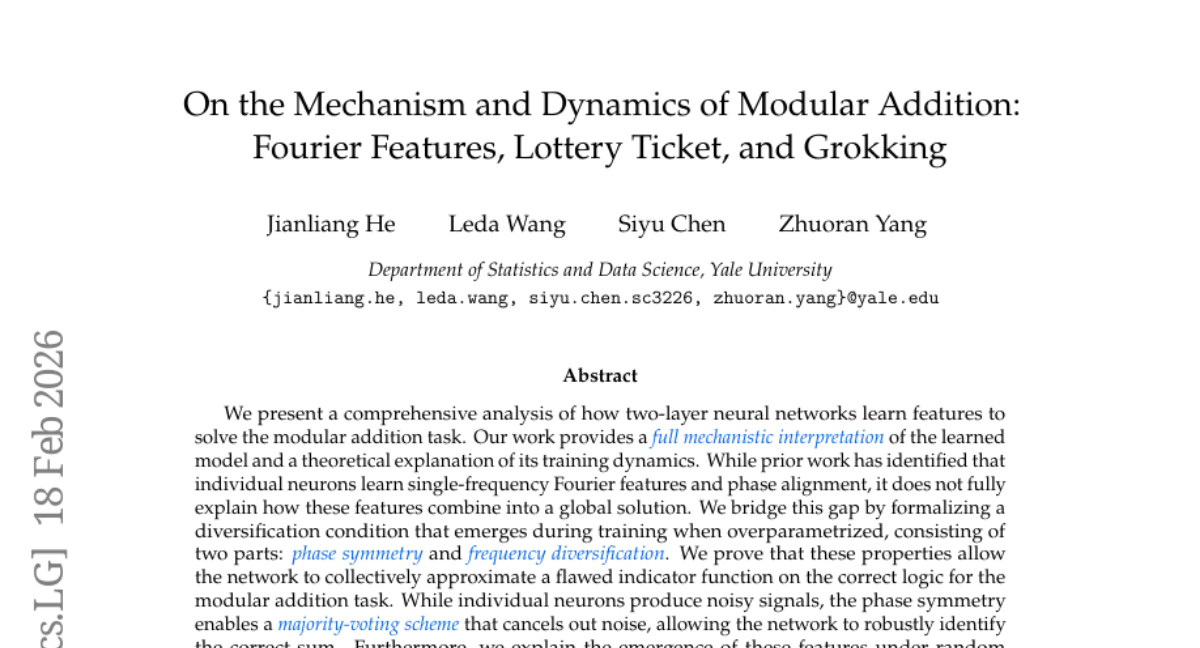
Understanding the internal representations learned by neural networks is a cornerstone challenge in the science of machine learning. While there have been significant recent strides in some cases towards understanding how neural networks implement specific target functions, this paper explores a complementary question -- why do networks arrive at particular computational strategies? Our inquiry focuses on the algebraic learning tasks of modular addition, sparse parities, and finite group operations. Our primary theoretical findings analytically characterize the features learned by stylized neural networks for these algebraic tasks. Notably, our main technique demonstrates how the principle of margin maximization alone can be used to fully specify the features learned by the network. Specifically, we prove that the trained networks utilize Fourier features to perform modular addition and employ features corresponding to irreducible group-theoretic representations to perform compositions in general groups, aligning closely with the empirical observations of Nanda et al. and Chughtai et al. More generally, we hope our techniques can help to foster a deeper understanding of why neural networks adopt specific computational strategies.
Questioning Representational Optimism in Deep Learning: The Fractured Entangled Representation Hypothesis
Much of the excitement in modern AI is driven by the observation that scaling up existing systems leads to better performance. But does better performance necessarily imply better internal representations? While the representational optimist assumes it must, this position paper challenges that view. We compare neural networks evolved through an open-ended search process to networks trained via conventional stochastic gradient descent (SGD) on the simple task of generating a single image. This minimal setup offers a unique advantage: each hidden neuron's full functional behavior can be easily visualized as an image, thus revealing how the network's output behavior is internally constructed neuron by neuron. The result is striking: while both networks produce the same output behavior, their internal representations differ dramatically. The SGD-trained networks exhibit a form of disorganization that we term fractured entangled representation (FER). Interestingly, the evolved networks largely lack FER, even approaching a unified factored representation (UFR). In large models, FER may be degrading core model capacities like generalization, creativity, and (continual) learning. Therefore, understanding and mitigating FER could be critical to the future of representation learning.
Towards Multimodal Understanding via Stable Diffusion as a Task-Aware Feature Extractor
Recent advances in multimodal large language models (MLLMs) have enabled image-based question-answering capabilities. However, a key limitation is the use of CLIP as the visual encoder; while it can capture coarse global information, it often can miss fine-grained details that are relevant to the input query. To address these shortcomings, this work studies whether pre-trained text-to-image diffusion models can serve as instruction-aware visual encoders. Through an analysis of their internal representations, we find diffusion features are both rich in semantics and can encode strong image-text alignment. Moreover, we find that we can leverage text conditioning to focus the model on regions relevant to the input question. We then investigate how to align these features with large language models and uncover a leakage phenomenon, where the LLM can inadvertently recover information from the original diffusion prompt. We analyze the causes of this leakage and propose a mitigation strategy. Based on these insights, we explore a simple fusion strategy that utilizes both CLIP and conditional diffusion features. We evaluate our approach on both general VQA and specialized MLLM benchmarks, demonstrating the promise of diffusion models for visual understanding, particularly in vision-centric tasks that require spatial and compositional reasoning. Our project page can be found https://vatsalag99.github.io/mustafar/.
Centaur: a foundation model of human cognition
Establishing a unified theory of cognition has been a major goal of psychology. While there have been previous attempts to instantiate such theories by building computational models, we currently do not have one model that captures the human mind in its entirety. Here we introduce Centaur, a computational model that can predict and simulate human behavior in any experiment expressible in natural language. We derived Centaur by finetuning a state-of-the-art language model on a novel, large-scale data set called Psych-101. Psych-101 reaches an unprecedented scale, covering trial-by-trial data from over 60,000 participants performing over 10,000,000 choices in 160 experiments. Centaur not only captures the behavior of held-out participants better than existing cognitive models, but also generalizes to new cover stories, structural task modifications, and entirely new domains. Furthermore, we find that the model's internal representations become more aligned with human neural activity after finetuning. Taken together, Centaur is the first real candidate for a unified model of human cognition. We anticipate that it will have a disruptive impact on the cognitive sciences, challenging the existing paradigm for developing computational models.
Sparse Neurons Carry Strong Signals of Question Ambiguity in LLMs
Ambiguity is pervasive in real-world questions, yet large language models (LLMs) often respond with confident answers rather than seeking clarification. In this work, we show that question ambiguity is linearly encoded in the internal representations of LLMs and can be both detected and controlled at the neuron level. During the model's pre-filling stage, we identify that a small number of neurons, as few as one, encode question ambiguity information. Probes trained on these Ambiguity-Encoding Neurons (AENs) achieve strong performance on ambiguity detection and generalize across datasets, outperforming prompting-based and representation-based baselines. Layerwise analysis reveals that AENs emerge from shallow layers, suggesting early encoding of ambiguity signals in the model's processing pipeline. Finally, we show that through manipulating AENs, we can control LLM's behavior from direct answering to abstention. Our findings reveal that LLMs form compact internal representations of question ambiguity, enabling interpretable and controllable behavior.
100% Hallucination Elimination Using Acurai
The issue of hallucinations in large language models (LLMs) remains a critical barrier to the adoption of AI in enterprise and other high-stakes applications. Despite advancements in retrieval-augmented generation (RAG) systems, current state-of-the-art methods fail to achieve more than 80% accuracy in generating faithful and factually correct outputs, even when provided with relevant and accurate context. In this work, we introduce Acurai, a novel systematic approach that achieves 100% hallucination-free responses in LLMs by reformatting queries and context data prior to input. Leveraging a deep understanding of LLM internal representations, the importance of noun-phrase dominance, and the role of discrete functional units (DFUs), Acurai ensures alignment between input context and generated output. We validate this method using the RAGTruth corpus, demonstrating its ability to eliminate 100% hallucinations for both GPT-4 and GPT-3.5 Turbo. Acurai sets a new standard for achieving consistent, accurate, and faithful AI responses, marking a significant step forward in the development of trustworthy AI systems.
A Contrastive Learning Approach to Mitigate Bias in Speech Models
Speech models may be affected by performance imbalance in different population subgroups, raising concerns about fair treatment across these groups. Prior attempts to mitigate unfairness either focus on user-defined subgroups, potentially overlooking other affected subgroups, or do not explicitly improve the internal representation at the subgroup level. This paper proposes the first adoption of contrastive learning to mitigate speech model bias in underperforming subgroups. We employ a three-level learning technique that guides the model in focusing on different scopes for the contrastive loss, i.e., task, subgroup, and the errors within subgroups. The experiments on two spoken language understanding datasets and two languages demonstrate that our approach improves internal subgroup representations, thus reducing model bias and enhancing performance.
Generalization Analogies: A Testbed for Generalizing AI Oversight to Hard-To-Measure Domains
As AI systems become more intelligent and their behavior becomes more challenging to assess, they may learn to game the flaws of human feedback instead of genuinely striving to follow instructions; however, this risk can be mitigated by controlling how LLMs generalize human feedback to situations where it is unreliable. To better understand how reward models generalize, we craft 69 distribution shifts spanning 8 categories. We find that reward models do not learn to evaluate `instruction-following' by default and instead favor personas that resemble internet text. Techniques for interpreting reward models' internal representations achieve better generalization than standard fine-tuning, but still frequently fail to distinguish instruction-following from conflated behaviors. We consolidate the 15 most challenging distribution shifts into the GENeralization analogIES (GENIES) benchmark, which we hope will enable progress toward controlling reward model generalization.
LLMs Know More Than They Show: On the Intrinsic Representation of LLM Hallucinations
Large language models (LLMs) often produce errors, including factual inaccuracies, biases, and reasoning failures, collectively referred to as "hallucinations". Recent studies have demonstrated that LLMs' internal states encode information regarding the truthfulness of their outputs, and that this information can be utilized to detect errors. In this work, we show that the internal representations of LLMs encode much more information about truthfulness than previously recognized. We first discover that the truthfulness information is concentrated in specific tokens, and leveraging this property significantly enhances error detection performance. Yet, we show that such error detectors fail to generalize across datasets, implying that -- contrary to prior claims -- truthfulness encoding is not universal but rather multifaceted. Next, we show that internal representations can also be used for predicting the types of errors the model is likely to make, facilitating the development of tailored mitigation strategies. Lastly, we reveal a discrepancy between LLMs' internal encoding and external behavior: they may encode the correct answer, yet consistently generate an incorrect one. Taken together, these insights deepen our understanding of LLM errors from the model's internal perspective, which can guide future research on enhancing error analysis and mitigation.
Turning the Spell Around: Lightweight Alignment Amplification via Rank-One Safety Injection
Safety alignment in Large Language Models (LLMs) often involves mediating internal representations to refuse harmful requests. Recent research has demonstrated that these safety mechanisms can be bypassed by ablating or removing specific representational directions within the model. In this paper, we propose the opposite approach: Rank-One Safety Injection (ROSI), a white-box method that amplifies a model's safety alignment by permanently steering its activations toward the refusal-mediating subspace. ROSI operates as a simple, fine-tuning-free rank-one weight modification applied to all residual stream write matrices. The required safety direction can be computed from a small set of harmful and harmless instruction pairs. We show that ROSI consistently increases safety refusal rates - as evaluated by Llama Guard 3 - while preserving the utility of the model on standard benchmarks such as MMLU, HellaSwag, and Arc. Furthermore, we show that ROSI can also re-align 'uncensored' models by amplifying their own latent safety directions, demonstrating its utility as an effective last-mile safety procedure. Our results suggest that targeted, interpretable weight steering is a cheap and potent mechanism to improve LLM safety, complementing more resource-intensive fine-tuning paradigms.
Do I Know This Entity? Knowledge Awareness and Hallucinations in Language Models
Hallucinations in large language models are a widespread problem, yet the mechanisms behind whether models will hallucinate are poorly understood, limiting our ability to solve this problem. Using sparse autoencoders as an interpretability tool, we discover that a key part of these mechanisms is entity recognition, where the model detects if an entity is one it can recall facts about. Sparse autoencoders uncover meaningful directions in the representation space, these detect whether the model recognizes an entity, e.g. detecting it doesn't know about an athlete or a movie. This suggests that models can have self-knowledge: internal representations about their own capabilities. These directions are causally relevant: capable of steering the model to refuse to answer questions about known entities, or to hallucinate attributes of unknown entities when it would otherwise refuse. We demonstrate that despite the sparse autoencoders being trained on the base model, these directions have a causal effect on the chat model's refusal behavior, suggesting that chat finetuning has repurposed this existing mechanism. Furthermore, we provide an initial exploration into the mechanistic role of these directions in the model, finding that they disrupt the attention of downstream heads that typically move entity attributes to the final token.
Teach Old SAEs New Domain Tricks with Boosting
Sparse Autoencoders have emerged as powerful tools for interpreting the internal representations of Large Language Models, yet they often fail to capture domain-specific features not prevalent in their training corpora. This paper introduces a residual learning approach that addresses this feature blindness without requiring complete retraining. We propose training a secondary SAE specifically to model the reconstruction error of a pretrained SAE on domain-specific texts, effectively capturing features missed by the primary model. By summing the outputs of both models during inference, we demonstrate significant improvements in both LLM cross-entropy and explained variance metrics across multiple specialized domains. Our experiments show that this method efficiently incorporates new domain knowledge into existing SAEs while maintaining their performance on general tasks. This approach enables researchers to selectively enhance SAE interpretability for specific domains of interest, opening new possibilities for targeted mechanistic interpretability of LLMs.
Geospatial Mechanistic Interpretability of Large Language Models
Large Language Models (LLMs) have demonstrated unprecedented capabilities across various natural language processing tasks. Their ability to process and generate viable text and code has made them ubiquitous in many fields, while their deployment as knowledge bases and "reasoning" tools remains an area of ongoing research. In geography, a growing body of literature has been focusing on evaluating LLMs' geographical knowledge and their ability to perform spatial reasoning. However, very little is still known about the internal functioning of these models, especially about how they process geographical information. In this chapter, we establish a novel framework for the study of geospatial mechanistic interpretability - using spatial analysis to reverse engineer how LLMs handle geographical information. Our aim is to advance our understanding of the internal representations that these complex models generate while processing geographical information - what one might call "how LLMs think about geographic information" if such phrasing was not an undue anthropomorphism. We first outline the use of probing in revealing internal structures within LLMs. We then introduce the field of mechanistic interpretability, discussing the superposition hypothesis and the role of sparse autoencoders in disentangling polysemantic internal representations of LLMs into more interpretable, monosemantic features. In our experiments, we use spatial autocorrelation to show how features obtained for placenames display spatial patterns related to their geographic location and can thus be interpreted geospatially, providing insights into how these models process geographical information. We conclude by discussing how our framework can help shape the study and use of foundation models in geography.
ICL CIPHERS: Quantifying "Learning'' in In-Context Learning via Substitution Ciphers
Recent works have suggested that In-Context Learning (ICL) operates in dual modes, i.e. task retrieval (remember learned patterns from pre-training) and task learning (inference-time ``learning'' from demonstrations). However, disentangling these the two modes remains a challenging goal. We introduce ICL CIPHERS, a class of task reformulations based on substitution ciphers borrowed from classic cryptography. In this approach, a subset of tokens in the in-context inputs are substituted with other (irrelevant) tokens, rendering English sentences less comprehensible to human eye. However, by design, there is a latent, fixed pattern to this substitution, making it reversible. This bijective (reversible) cipher ensures that the task remains a well-defined task in some abstract sense, despite the transformations. It is a curious question if LLMs can solve ICL CIPHERS with a BIJECTIVE mapping, which requires deciphering the latent cipher. We show that LLMs are better at solving ICL CIPHERS with BIJECTIVE mappings than the NON-BIJECTIVE (irreversible) baseline, providing a novel approach to quantify ``learning'' in ICL. While this gap is small, it is consistent across the board on four datasets and six models. Finally, we examine LLMs' internal representations and identify evidence in their ability to decode the ciphered inputs.
Diffusion Self-Guidance for Controllable Image Generation
Large-scale generative models are capable of producing high-quality images from detailed text descriptions. However, many aspects of an image are difficult or impossible to convey through text. We introduce self-guidance, a method that provides greater control over generated images by guiding the internal representations of diffusion models. We demonstrate that properties such as the shape, location, and appearance of objects can be extracted from these representations and used to steer sampling. Self-guidance works similarly to classifier guidance, but uses signals present in the pretrained model itself, requiring no additional models or training. We show how a simple set of properties can be composed to perform challenging image manipulations, such as modifying the position or size of objects, merging the appearance of objects in one image with the layout of another, composing objects from many images into one, and more. We also show that self-guidance can be used to edit real images. For results and an interactive demo, see our project page at https://dave.ml/selfguidance/
Residual Stream Analysis with Multi-Layer SAEs
Sparse autoencoders (SAEs) are a promising approach to interpreting the internal representations of transformer language models. However, standard SAEs are trained separately on each transformer layer, making it difficult to use them to study how information flows across layers. To solve this problem, we introduce the multi-layer SAE (MLSAE): a single SAE trained on the residual stream activation vectors from every transformer layer simultaneously. The residual stream is usually understood as preserving information across layers, so we expected to, and did, find individual SAE features that are active at multiple layers. Interestingly, while a single SAE feature is active at different layers for different prompts, for a single prompt, we find that a single feature is far more likely to be active at a single layer. For larger underlying models, we find that the cosine similarities between adjacent layers in the residual stream are higher, so we expect more features to be active at multiple layers. These results show that MLSAEs are a promising method to study information flow in transformers. We release our code to train and analyze MLSAEs at https://github.com/tim-lawson/mlsae.
TruthX: Alleviating Hallucinations by Editing Large Language Models in Truthful Space
Large Language Models (LLMs) have demonstrated remarkable capabilities across various tasks. However, they sometimes suffer from producing hallucinations, particularly in cases where they may generate untruthful responses despite possessing the correct knowledge. In this paper, we propose TruthX, an inference-time method to elicit the truthfulness of LLMs by editing their internal representations in truthful space. TruthX employs an auto-encoder to map LLM's representations into semantic and truthful latent spaces respectively, and applies contrastive learning to identify a truthful editing direction within the truthful space. During inference, by editing LLM's internal representations in truthful space, TruthX effectively enhances the truthfulness of LLMs. Experiments show that TruthX effectively improves the truthfulness of 13 advanced LLMs by an average of 20% on TruthfulQA benchmark. Further analyses suggest that the truthful space acquired by TruthX plays a pivotal role in controlling LLM to produce truthful or hallucinatory responses.
Brain-Language Model Alignment: Insights into the Platonic Hypothesis and Intermediate-Layer Advantage
Do brains and language models converge toward the same internal representations of the world? Recent years have seen a rise in studies of neural activations and model alignment. In this work, we review 25 fMRI-based studies published between 2023 and 2025 and explicitly confront their findings with two key hypotheses: (i) the Platonic Representation Hypothesis -- that as models scale and improve, they converge to a representation of the real world, and (ii) the Intermediate-Layer Advantage -- that intermediate (mid-depth) layers often encode richer, more generalizable features. Our findings provide converging evidence that models and brains may share abstract representational structures, supporting both hypotheses and motivating further research on brain-model alignment.
Visualizing Thought: Conceptual Diagrams Enable Robust Planning in LMMs
Human reasoning relies on constructing and manipulating mental models-simplified internal representations of situations that we use to understand and solve problems. Conceptual diagrams (for example, sketches drawn by humans to aid reasoning) externalize these mental models, abstracting irrelevant details to efficiently capture relational and spatial information. In contrast, Large Language Models (LLMs) and Large Multimodal Models (LMMs) predominantly reason through textual representations, limiting their effectiveness in complex multi-step combinatorial and planning tasks. In this paper, we propose a zero-shot fully automatic framework that enables LMMs to reason through multiple chains of self-generated intermediate conceptual diagrams, significantly enhancing their combinatorial planning capabilities. Our approach does not require any human initialization beyond a natural language description of the task. It integrates both textual and diagrammatic reasoning within an optimized graph-of-thought inference framework, enhanced by beam search and depth-wise backtracking. Evaluated on multiple challenging PDDL planning domains, our method substantially improves GPT-4o's performance (for example, from 35.5% to 90.2% in Blocksworld). On more difficult planning domains with solution depths up to 40, our approach outperforms even the o1-preview reasoning model (for example, over 13% improvement in Parking). These results highlight the value of conceptual diagrams as a complementary reasoning medium in LMMs.
Training the Untrainable: Introducing Inductive Bias via Representational Alignment
We demonstrate that architectures which traditionally are considered to be ill-suited for a task can be trained using inductive biases from another architecture. Networks are considered untrainable when they overfit, underfit, or converge to poor results even when tuning their hyperparameters. For example, plain fully connected networks overfit on object recognition while deep convolutional networks without residual connections underfit. The traditional answer is to change the architecture to impose some inductive bias, although what that bias is remains unknown. We introduce guidance, where a guide network guides a target network using a neural distance function. The target is optimized to perform well and to match its internal representations, layer-by-layer, to those of the guide; the guide is unchanged. If the guide is trained, this transfers over part of the architectural prior and knowledge of the guide to the target. If the guide is untrained, this transfers over only part of the architectural prior of the guide. In this manner, we can investigate what kinds of priors different architectures place on untrainable networks such as fully connected networks. We demonstrate that this method overcomes the immediate overfitting of fully connected networks on vision tasks, makes plain CNNs competitive to ResNets, closes much of the gap between plain vanilla RNNs and Transformers, and can even help Transformers learn tasks which RNNs can perform more easily. We also discover evidence that better initializations of fully connected networks likely exist to avoid overfitting. Our method provides a mathematical tool to investigate priors and architectures, and in the long term, may demystify the dark art of architecture creation, even perhaps turning architectures into a continuous optimizable parameter of the network.
Deciphering the Interplay of Parametric and Non-parametric Memory in Retrieval-augmented Language Models
Generative language models often struggle with specialized or less-discussed knowledge. A potential solution is found in Retrieval-Augmented Generation (RAG) models which act like retrieving information before generating responses. In this study, we explore how the Atlas approach, a RAG model, decides between what it already knows (parametric) and what it retrieves (non-parametric). We use causal mediation analysis and controlled experiments to examine how internal representations influence information processing. Our findings disentangle the effects of parametric knowledge and the retrieved context. They indicate that in cases where the model can choose between both types of information (parametric and non-parametric), it relies more on the context than the parametric knowledge. Furthermore, the analysis investigates the computations involved in how the model uses the information from the context. We find that multiple mechanisms are active within the model and can be detected with mediation analysis: first, the decision of whether the context is relevant, and second, how the encoder computes output representations to support copying when relevant.
Do Music Generation Models Encode Music Theory?
Music foundation models possess impressive music generation capabilities. When people compose music, they may infuse their understanding of music into their work, by using notes and intervals to craft melodies, chords to build progressions, and tempo to create a rhythmic feel. To what extent is this true of music generation models? More specifically, are fundamental Western music theory concepts observable within the "inner workings" of these models? Recent work proposed leveraging latent audio representations from music generation models towards music information retrieval tasks (e.g. genre classification, emotion recognition), which suggests that high-level musical characteristics are encoded within these models. However, probing individual music theory concepts (e.g. tempo, pitch class, chord quality) remains under-explored. Thus, we introduce SynTheory, a synthetic MIDI and audio music theory dataset, consisting of tempos, time signatures, notes, intervals, scales, chords, and chord progressions concepts. We then propose a framework to probe for these music theory concepts in music foundation models (Jukebox and MusicGen) and assess how strongly they encode these concepts within their internal representations. Our findings suggest that music theory concepts are discernible within foundation models and that the degree to which they are detectable varies by model size and layer.
A Concept-Based Explainability Framework for Large Multimodal Models
Large multimodal models (LMMs) combine unimodal encoders and large language models (LLMs) to perform multimodal tasks. Despite recent advancements towards the interpretability of these models, understanding internal representations of LMMs remains largely a mystery. In this paper, we present a novel framework for the interpretation of LMMs. We propose a dictionary learning based approach, applied to the representation of tokens. The elements of the learned dictionary correspond to our proposed concepts. We show that these concepts are well semantically grounded in both vision and text. Thus we refer to these as ``multi-modal concepts''. We qualitatively and quantitatively evaluate the results of the learnt concepts. We show that the extracted multimodal concepts are useful to interpret representations of test samples. Finally, we evaluate the disentanglement between different concepts and the quality of grounding concepts visually and textually. Our code is publicly available at https://github.com/mshukor/xl-vlms
Overthinking the Truth: Understanding how Language Models Process False Demonstrations
Modern language models can imitate complex patterns through few-shot learning, enabling them to complete challenging tasks without fine-tuning. However, imitation can also lead models to reproduce inaccuracies or harmful content if present in the context. We study harmful imitation through the lens of a model's internal representations, and identify two related phenomena: "overthinking" and "false induction heads". The first phenomenon, overthinking, appears when we decode predictions from intermediate layers, given correct vs. incorrect few-shot demonstrations. At early layers, both demonstrations induce similar model behavior, but the behavior diverges sharply at some "critical layer", after which the accuracy given incorrect demonstrations progressively decreases. The second phenomenon, false induction heads, are a possible mechanistic cause of overthinking: these are heads in late layers that attend to and copy false information from previous demonstrations, and whose ablation reduces overthinking. Beyond scientific understanding, our results suggest that studying intermediate model computations could be a promising avenue for understanding and guarding against harmful model behaviors.
Augmentation Invariant Discrete Representation for Generative Spoken Language Modeling
Generative Spoken Language Modeling research focuses on optimizing speech Language Models (LMs) using raw audio recordings without accessing any textual supervision. Such speech LMs usually operate over discrete units obtained from quantizing internal representations of self-supervised models. Although such units show impressive modeling results, their robustness capabilities have not been extensively investigated. This work focuses on improving the robustness of discrete input representations for generative spoken language modeling. First, we formally define how to measure the robustness of such representations to various signal variations that do not alter the spoken information (e.g., time-stretch). Next, we empirically demonstrate how current state-of-the-art representation models lack robustness to such variations. To overcome this, we propose an effective and efficient method to learn robust discrete speech representation for generative spoken language modeling. The proposed approach is based on applying a set of signal transformations to the speech signal and optimizing the model using an iterative pseudo-labeling scheme. Our method significantly improves over the evaluated baselines when considering encoding and modeling metrics. We additionally evaluate our method on the speech-to-speech translation task, considering Spanish-English and French-English translations, and show the proposed approach outperforms the evaluated baselines.
Latent Collaboration in Multi-Agent Systems
Multi-agent systems (MAS) extend large language models (LLMs) from independent single-model reasoning to coordinative system-level intelligence. While existing LLM agents depend on text-based mediation for reasoning and communication, we take a step forward by enabling models to collaborate directly within the continuous latent space. We introduce LatentMAS, an end-to-end training-free framework that enables pure latent collaboration among LLM agents. In LatentMAS, each agent first performs auto-regressive latent thoughts generation through last-layer hidden embeddings. A shared latent working memory then preserves and transfers each agent's internal representations, ensuring lossless information exchange. We provide theoretical analyses establishing that LatentMAS attains higher expressiveness and lossless information preservation with substantially lower complexity than vanilla text-based MAS. In addition, empirical evaluations across 9 comprehensive benchmarks spanning math and science reasoning, commonsense understanding, and code generation show that LatentMAS consistently outperforms strong single-model and text-based MAS baselines, achieving up to 14.6% higher accuracy, reducing output token usage by 70.8%-83.7%, and providing 4x-4.3x faster end-to-end inference. These results demonstrate that our new latent collaboration framework enhances system-level reasoning quality while offering substantial efficiency gains without any additional training. Code and data are fully open-sourced at https://github.com/Gen-Verse/LatentMAS.
Large Language Models Do NOT Really Know What They Don't Know
Recent work suggests that large language models (LLMs) encode factuality signals in their internal representations, such as hidden states, attention weights, or token probabilities, implying that LLMs may "know what they don't know". However, LLMs can also produce factual errors by relying on shortcuts or spurious associations. These error are driven by the same training objective that encourage correct predictions, raising the question of whether internal computations can reliably distinguish between factual and hallucinated outputs. In this work, we conduct a mechanistic analysis of how LLMs internally process factual queries by comparing two types of hallucinations based on their reliance on subject information. We find that when hallucinations are associated with subject knowledge, LLMs employ the same internal recall process as for correct responses, leading to overlapping and indistinguishable hidden-state geometries. In contrast, hallucinations detached from subject knowledge produce distinct, clustered representations that make them detectable. These findings reveal a fundamental limitation: LLMs do not encode truthfulness in their internal states but only patterns of knowledge recall, demonstrating that "LLMs don't really know what they don't know".
Spatial Mental Modeling from Limited Views
Can Vision Language Models (VLMs) imagine the full scene from just a few views, like humans do? Humans form spatial mental models, internal representations of unseen space, to reason about layout, perspective, and motion. Our new MindCube benchmark with 21,154 questions across 3,268 images exposes this critical gap, where existing VLMs exhibit near-random performance. Using MindCube, we systematically evaluate how well VLMs build robust spatial mental models through representing positions (cognitive mapping), orientations (perspective-taking), and dynamics (mental simulation for "what-if" movements). We then explore three approaches to help VLMs approximate spatial mental models, including unseen intermediate views, natural language reasoning chains, and cognitive maps. The significant improvement comes from a synergistic approach, "map-then-reason", that jointly trains the model to first generate a cognitive map and then reason upon it. By training models to reason over these internal maps, we boosted accuracy from 37.8% to 60.8% (+23.0%). Adding reinforcement learning pushed performance even further to 70.7% (+32.9%). Our key insight is that such scaffolding of spatial mental models, actively constructing and utilizing internal structured spatial representations with flexible reasoning processes, significantly improves understanding of unobservable space.
Attention IoU: Examining Biases in CelebA using Attention Maps
Computer vision models have been shown to exhibit and amplify biases across a wide array of datasets and tasks. Existing methods for quantifying bias in classification models primarily focus on dataset distribution and model performance on subgroups, overlooking the internal workings of a model. We introduce the Attention-IoU (Attention Intersection over Union) metric and related scores, which use attention maps to reveal biases within a model's internal representations and identify image features potentially causing the biases. First, we validate Attention-IoU on the synthetic Waterbirds dataset, showing that the metric accurately measures model bias. We then analyze the CelebA dataset, finding that Attention-IoU uncovers correlations beyond accuracy disparities. Through an investigation of individual attributes through the protected attribute of Male, we examine the distinct ways biases are represented in CelebA. Lastly, by subsampling the training set to change attribute correlations, we demonstrate that Attention-IoU reveals potential confounding variables not present in dataset labels.
Mechanistic interpretability for steering vision-language-action models
Vision-Language-Action (VLA) models are a promising path to realizing generalist embodied agents that can quickly adapt to new tasks, modalities, and environments. However, methods for interpreting and steering VLAs fall far short of classical robotics pipelines, which are grounded in explicit models of kinematics, dynamics, and control. This lack of mechanistic insight is a central challenge for deploying learned policies in real-world robotics, where robustness and explainability are critical. Motivated by advances in mechanistic interpretability for large language models, we introduce the first framework for interpreting and steering VLAs via their internal representations, enabling direct intervention in model behavior at inference time. We project feedforward activations within transformer layers onto the token embedding basis, identifying sparse semantic directions - such as speed and direction - that are causally linked to action selection. Leveraging these findings, we introduce a general-purpose activation steering method that modulates behavior in real time, without fine-tuning, reward signals, or environment interaction. We evaluate this method on two recent open-source VLAs, Pi0 and OpenVLA, and demonstrate zero-shot behavioral control in simulation (LIBERO) and on a physical robot (UR5). This work demonstrates that interpretable components of embodied VLAs can be systematically harnessed for control - establishing a new paradigm for transparent and steerable foundation models in robotics.
Interpretability as Compression: Reconsidering SAE Explanations of Neural Activations with MDL-SAEs
Sparse Autoencoders (SAEs) have emerged as a useful tool for interpreting the internal representations of neural networks. However, naively optimising SAEs for reconstruction loss and sparsity results in a preference for SAEs that are extremely wide and sparse. We present an information-theoretic framework for interpreting SAEs as lossy compression algorithms for communicating explanations of neural activations. We appeal to the Minimal Description Length (MDL) principle to motivate explanations of activations which are both accurate and concise. We further argue that interpretable SAEs require an additional property, "independent additivity": features should be able to be understood separately. We demonstrate an example of applying our MDL-inspired framework by training SAEs on MNIST handwritten digits and find that SAE features representing significant line segments are optimal, as opposed to SAEs with features for memorised digits from the dataset or small digit fragments. We argue that using MDL rather than sparsity may avoid potential pitfalls with naively maximising sparsity such as undesirable feature splitting and that this framework naturally suggests new hierarchical SAE architectures which provide more concise explanations.
Tracing the Traces: Latent Temporal Signals for Efficient and Accurate Reasoning
Reasoning models improve their problem-solving ability through inference-time scaling, allocating more compute via longer token budgets. Identifying which reasoning traces are likely to succeed remains a key opportunity: reliably predicting productive paths can substantially reduce wasted computation and improve overall efficiency. We introduce Latent-Trajectory signals that characterize the temporal evolution of a model's internal representations during the generation of intermediate reasoning tokens. By measuring the overall change in latent representations between the start and end of reasoning, the change accumulated across intermediate steps, and the extent to which these changes advance toward the final state, we show that these signals predict solution accuracy more reliably than both cross-layer metrics and output-based confidence measures. When used to guide answer selection across multiple sampled generations, Latent-Trajectory signals make test-time scaling more effective and efficient than majority voting, reducing token usage by up to 70% while preserving and even improving accuracy by 2.6% on average. Moreover, these predictive signals often emerge early in the reasoning trace, enabling early selection and allocation of compute to the most promising candidates. Our findings contribute not only practical strategies for inference-time efficiency, but also a deeper interpretability perspective on how reasoning processes are represented and differentiated in latent space.
What do self-supervised speech models know about Dutch? Analyzing advantages of language-specific pre-training
How language-specific are speech representations learned by self-supervised models? Existing work has shown that a range of linguistic features can be successfully decoded from end-to-end models trained only on speech recordings. However, it's less clear to what extent pre-training on specific languages improves language-specific linguistic information. Here we test the encoding of Dutch phonetic and lexical information in internal representations of self-supervised Wav2Vec2 models. Pre-training exclusively on Dutch improves the representation of Dutch linguistic features as compared to pre-training on similar amounts of English or larger amounts of multilingual data. This language-specific advantage is well-detected by trained clustering or classification probes, and partially observable using zero-shot metrics. Furthermore, the language-specific benefit on linguistic feature encoding aligns with downstream performance on Automatic Speech Recognition.
Interpreting and Steering Protein Language Models through Sparse Autoencoders
The rapid advancements in transformer-based language models have revolutionized natural language processing, yet understanding the internal mechanisms of these models remains a significant challenge. This paper explores the application of sparse autoencoders (SAE) to interpret the internal representations of protein language models, specifically focusing on the ESM-2 8M parameter model. By performing a statistical analysis on each latent component's relevance to distinct protein annotations, we identify potential interpretations linked to various protein characteristics, including transmembrane regions, binding sites, and specialized motifs. We then leverage these insights to guide sequence generation, shortlisting the relevant latent components that can steer the model towards desired targets such as zinc finger domains. This work contributes to the emerging field of mechanistic interpretability in biological sequence models, offering new perspectives on model steering for sequence design.
A Spectral Condition for Feature Learning
The push to train ever larger neural networks has motivated the study of initialization and training at large network width. A key challenge is to scale training so that a network's internal representations evolve nontrivially at all widths, a process known as feature learning. Here, we show that feature learning is achieved by scaling the spectral norm of weight matrices and their updates like texttt{fan-out/fan-in}, in contrast to widely used but heuristic scalings based on Frobenius norm and entry size. Our spectral scaling analysis also leads to an elementary derivation of maximal update parametrization. All in all, we aim to provide the reader with a solid conceptual understanding of feature learning in neural networks.
Language Arithmetics: Towards Systematic Language Neuron Identification and Manipulation
Large language models (LLMs) exhibit strong multilingual abilities, yet the neural mechanisms behind language-specific processing remain unclear. We analyze language-specific neurons in Llama-3.1-8B, Mistral-Nemo-12B, and Aya-Expanse-8B & 32B across 21 typologically diverse languages, identifying neurons that control language behavior. Using the Language Activation Probability Entropy (LAPE) method, we show that these neurons cluster in deeper layers, with non-Latin scripts showing greater specialization. Related languages share overlapping neurons, reflecting internal representations of linguistic proximity. Through language arithmetics, i.e. systematic activation addition and multiplication, we steer models to deactivate unwanted languages and activate desired ones, outperforming simpler replacement approaches. These interventions effectively guide behavior across five multilingual tasks: language forcing, translation, QA, comprehension, and NLI. Manipulation is more successful for high-resource languages, while typological similarity improves effectiveness. We also demonstrate that cross-lingual neuron steering enhances downstream performance and reveal internal "fallback" mechanisms for language selection when neurons are progressively deactivated. Our code is made publicly available at https://github.com/d-gurgurov/Language-Neurons-Manipulation.
Evaluating Generalization and Representation Stability in Small LMs via Prompting, Fine-Tuning and Out-of-Distribution Prompts
We investigate the generalization capabilities of small language models under two popular adaptation paradigms: few-shot prompting and supervised fine-tuning. While prompting is often favored for its parameter efficiency and flexibility, it remains unclear how robust this approach is in low-resource settings and under distributional shifts. This paper presents a comparative study of prompting and fine-tuning across task formats, prompt styles, and model scales, with a focus on their behavior in both in-distribution and out-of-distribution (OOD) settings. Beyond accuracy, we analyze the internal representations learned by each approach to assess the stability and abstraction of task-specific features. Our findings highlight critical differences in how small models internalize and generalize knowledge under different adaptation strategies. This work offers practical guidance for model selection in low-data regimes and contributes empirical insight into the ongoing debate over prompting versus fine-tuning. Code for the experiments is available at the following
Reinforcement Learning for Aligning Large Language Models Agents with Interactive Environments: Quantifying and Mitigating Prompt Overfitting
Reinforcement learning (RL) is a promising approach for aligning large language models (LLMs) knowledge with sequential decision-making tasks. However, few studies have thoroughly investigated the impact on LLM agents capabilities of fine-tuning them with RL in a specific environment. In this paper, we propose a novel framework to analyze the sensitivity of LLMs to prompt formulations following RL training in a textual environment. Our findings reveal that the performance of LLMs degrades when faced with prompt formulations different from those used during the RL training phase. Besides, we analyze the source of this sensitivity by examining the model's internal representations and salient tokens. Finally, we propose to use a contrastive loss to mitigate this sensitivity and improve the robustness and generalization capabilities of LLMs.
Causal Language Modeling Can Elicit Search and Reasoning Capabilities on Logic Puzzles
Causal language modeling using the Transformer architecture has yielded remarkable capabilities in Large Language Models (LLMs) over the last few years. However, the extent to which fundamental search and reasoning capabilities emerged within LLMs remains a topic of ongoing debate. In this work, we study if causal language modeling can learn a complex task such as solving Sudoku puzzles. To solve a Sudoku, the model is first required to search over all empty cells of the puzzle to decide on a cell to fill and then apply an appropriate strategy to fill the decided cell. Sometimes, the application of a strategy only results in thinning down the possible values in a cell rather than concluding the exact value of the cell. In such cases, multiple strategies are applied one after the other to fill a single cell. We observe that Transformer models trained on this synthetic task can indeed learn to solve Sudokus (our model solves 94.21% of the puzzles fully correctly) when trained on a logical sequence of steps taken by a solver. We find that training Transformers with the logical sequence of steps is necessary and without such training, they fail to learn Sudoku. We also extend our analysis to Zebra puzzles (known as Einstein puzzles) and show that the model solves 92.04 % of the puzzles fully correctly. In addition, we study the internal representations of the trained Transformer and find that through linear probing, we can decode information about the set of possible values in any given cell from them, pointing to the presence of a strong reasoning engine implicit in the Transformer weights.
Alias-Free Generative Adversarial Networks
We observe that despite their hierarchical convolutional nature, the synthesis process of typical generative adversarial networks depends on absolute pixel coordinates in an unhealthy manner. This manifests itself as, e.g., detail appearing to be glued to image coordinates instead of the surfaces of depicted objects. We trace the root cause to careless signal processing that causes aliasing in the generator network. Interpreting all signals in the network as continuous, we derive generally applicable, small architectural changes that guarantee that unwanted information cannot leak into the hierarchical synthesis process. The resulting networks match the FID of StyleGAN2 but differ dramatically in their internal representations, and they are fully equivariant to translation and rotation even at subpixel scales. Our results pave the way for generative models better suited for video and animation.
Bilinear relational structure fixes reversal curse and enables consistent model editing
The reversal curse -- a language model's (LM) inability to infer an unseen fact ``B is A'' from a learned fact ``A is B'' -- is widely considered a fundamental limitation. We show that this is not an inherent failure but an artifact of how models encode knowledge. By training LMs from scratch on a synthetic dataset of relational knowledge graphs, we demonstrate that bilinear relational structure emerges in their hidden representations. This structure substantially alleviates the reversal curse, enabling LMs to infer unseen reverse facts. Crucially, we also find that this bilinear structure plays a key role in consistent model editing. When a fact is updated in a LM with this structure, the edit correctly propagates to its reverse and other logically dependent facts. In contrast, models lacking this representation not only suffer from the reversal curse but also fail to generalize edits, further introducing logical inconsistencies. Our results establish that training on a relational knowledge dataset induces the emergence of bilinear internal representations, which in turn enable LMs to behave in a logically consistent manner after editing. This implies that the success of model editing depends critically not just on editing algorithms but on the underlying representational geometry of the knowledge being modified.
Memorization-Compression Cycles Improve Generalization
We prove theoretically that generalization improves not only through data scaling but also by compressing internal representations. To operationalize this insight, we introduce the Information Bottleneck Language Modeling (IBLM) objective, which reframes language modeling as a constrained optimization problem: minimizing representation entropy subject to optimal prediction performance. Empirically, we observe an emergent memorization-compression cycle during LLM pretraining, evidenced by oscillation positive/negative gradient alignment between cross-entropy and Matrix-Based Entropy (MBE), a measure of representation entropy. This pattern closely mirrors the predictive-compressive trade-off prescribed by IBLM and also parallels the biological alternation between awake learning and sleep consolidation. Motivated by this observation, we propose Gated Phase Transition (GAPT), a training algorithm that adaptively switches between memorization and compression phases. When applied to GPT-2 pretraining on FineWeb dataset, GAPT reduces MBE by 50% and improves cross-entropy by 4.8%. GAPT improves OOD generalizatino by 35% in a pretraining task on arithmetic multiplication. In a setting designed to simulate catastrophic forgetting, GAPT reduces interference by compressing and separating representations, achieving a 97% improvement in separation - paralleling the functional role of sleep consolidation.
Cache-to-Cache: Direct Semantic Communication Between Large Language Models
Multi-LLM systems harness the complementary strengths of diverse Large Language Models, achieving performance and efficiency gains unattainable by a single model. In existing designs, LLMs communicate through text, forcing internal representations to be transformed into output token sequences. This process both loses rich semantic information and incurs token-by-token generation latency. Motivated by these limitations, we ask: Can LLMs communicate beyond text? Oracle experiments show that enriching the KV-Cache semantics can improve response quality without increasing cache size, supporting KV-Cache as an effective medium for inter-model communication. Thus, we propose Cache-to-Cache (C2C), a new paradigm for direct semantic communication between LLMs. C2C uses a neural network to project and fuse the source model's KV-cache with that of the target model to enable direct semantic transfer. A learnable gating mechanism selects the target layers that benefit from cache communication. Compared with text communication, C2C utilizes the deep, specialized semantics from both models, while avoiding explicit intermediate text generation. Experiments show that C2C achieves 8.5-10.5% higher average accuracy than individual models. It further outperforms the text communication paradigm by approximately 3.0-5.0%, while delivering an average 2.0x speedup in latency. Our code is available at https://github.com/thu-nics/C2C.
False Sense of Security: Why Probing-based Malicious Input Detection Fails to Generalize
Large Language Models (LLMs) can comply with harmful instructions, raising serious safety concerns despite their impressive capabilities. Recent work has leveraged probing-based approaches to study the separability of malicious and benign inputs in LLMs' internal representations, and researchers have proposed using such probing methods for safety detection. We systematically re-examine this paradigm. Motivated by poor out-of-distribution performance, we hypothesize that probes learn superficial patterns rather than semantic harmfulness. Through controlled experiments, we confirm this hypothesis and identify the specific patterns learned: instructional patterns and trigger words. Our investigation follows a systematic approach, progressing from demonstrating comparable performance of simple n-gram methods, to controlled experiments with semantically cleaned datasets, to detailed analysis of pattern dependencies. These results reveal a false sense of security around current probing-based approaches and highlight the need to redesign both models and evaluation protocols, for which we provide further discussions in the hope of suggesting responsible further research in this direction. We have open-sourced the project at https://github.com/WangCheng0116/Why-Probe-Fails.
Memorizing Transformers
Language models typically need to be trained or finetuned in order to acquire new knowledge, which involves updating their weights. We instead envision language models that can simply read and memorize new data at inference time, thus acquiring new knowledge immediately. In this work, we extend language models with the ability to memorize the internal representations of past inputs. We demonstrate that an approximate kNN lookup into a non-differentiable memory of recent (key, value) pairs improves language modeling across various benchmarks and tasks, including generic webtext (C4), math papers (arXiv), books (PG-19), code (Github), as well as formal theorems (Isabelle). We show that the performance steadily improves when we increase the size of memory up to 262K tokens. On benchmarks including code and mathematics, we find that the model is capable of making use of newly defined functions and theorems during test time.
Embodied AI: From LLMs to World Models
Embodied Artificial Intelligence (AI) is an intelligent system paradigm for achieving Artificial General Intelligence (AGI), serving as the cornerstone for various applications and driving the evolution from cyberspace to physical systems. Recent breakthroughs in Large Language Models (LLMs) and World Models (WMs) have drawn significant attention for embodied AI. On the one hand, LLMs empower embodied AI via semantic reasoning and task decomposition, bringing high-level natural language instructions and low-level natural language actions into embodied cognition. On the other hand, WMs empower embodied AI by building internal representations and future predictions of the external world, facilitating physical law-compliant embodied interactions. As such, this paper comprehensively explores the literature in embodied AI from basics to advances, covering both LLM driven and WM driven works. In particular, we first present the history, key technologies, key components, and hardware systems of embodied AI, as well as discuss its development via looking from unimodal to multimodal angle. We then scrutinize the two burgeoning fields of embodied AI, i.e., embodied AI with LLMs/multimodal LLMs (MLLMs) and embodied AI with WMs, meticulously delineating their indispensable roles in end-to-end embodied cognition and physical laws-driven embodied interactions. Building upon the above advances, we further share our insights on the necessity of the joint MLLM-WM driven embodied AI architecture, shedding light on its profound significance in enabling complex tasks within physical worlds. In addition, we examine representative applications of embodied AI, demonstrating its wide applicability in real-world scenarios. Last but not least, we point out future research directions of embodied AI that deserve further investigation.
X2Edit: Revisiting Arbitrary-Instruction Image Editing through Self-Constructed Data and Task-Aware Representation Learning
Existing open-source datasets for arbitrary-instruction image editing remain suboptimal, while a plug-and-play editing module compatible with community-prevalent generative models is notably absent. In this paper, we first introduce the X2Edit Dataset, a comprehensive dataset covering 14 diverse editing tasks, including subject-driven generation. We utilize the industry-leading unified image generation models and expert models to construct the data. Meanwhile, we design reasonable editing instructions with the VLM and implement various scoring mechanisms to filter the data. As a result, we construct 3.7 million high-quality data with balanced categories. Second, to better integrate seamlessly with community image generation models, we design task-aware MoE-LoRA training based on FLUX.1, with only 8\% of the parameters of the full model. To further improve the final performance, we utilize the internal representations of the diffusion model and define positive/negative samples based on image editing types to introduce contrastive learning. Extensive experiments demonstrate that the model's editing performance is competitive among many excellent models. Additionally, the constructed dataset exhibits substantial advantages over existing open-source datasets. The open-source code, checkpoints, and datasets for X2Edit can be found at the following link: https://github.com/OPPO-Mente-Lab/X2Edit.
Sticking to the Mean: Detecting Sticky Tokens in Text Embedding Models
Despite the widespread use of Transformer-based text embedding models in NLP tasks, surprising 'sticky tokens' can undermine the reliability of embeddings. These tokens, when repeatedly inserted into sentences, pull sentence similarity toward a certain value, disrupting the normal distribution of embedding distances and degrading downstream performance. In this paper, we systematically investigate such anomalous tokens, formally defining them and introducing an efficient detection method, Sticky Token Detector (STD), based on sentence and token filtering. Applying STD to 40 checkpoints across 14 model families, we discover a total of 868 sticky tokens. Our analysis reveals that these tokens often originate from special or unused entries in the vocabulary, as well as fragmented subwords from multilingual corpora. Notably, their presence does not strictly correlate with model size or vocabulary size. We further evaluate how sticky tokens affect downstream tasks like clustering and retrieval, observing significant performance drops of up to 50%. Through attention-layer analysis, we show that sticky tokens disproportionately dominate the model's internal representations, raising concerns about tokenization robustness. Our findings show the need for better tokenization strategies and model design to mitigate the impact of sticky tokens in future text embedding applications.
Active Layer-Contrastive Decoding Reduces Hallucination in Large Language Model Generation
Recent decoding methods improve the factuality of large language models (LLMs) by refining how the next token is selected during generation. These methods typically operate at the token level, leveraging internal representations to suppress superficial patterns. Nevertheless, LLMs remain prone to hallucinations, especially over longer contexts. In this paper, we propose Active Layer-Contrastive Decoding (ActLCD), a novel decoding strategy that actively decides when to apply contrasting layers during generation. By casting decoding as a sequential decision-making problem, ActLCD employs a reinforcement learning policy guided by a reward-aware classifier to optimize factuality beyond the token level. Our experiments demonstrate that ActLCD surpasses state-of-the-art methods across five benchmarks, showcasing its effectiveness in mitigating hallucinations in diverse generation scenarios.
From Tokens to Thoughts: How LLMs and Humans Trade Compression for Meaning
Humans organize knowledge into compact categories through semantic compression by mapping diverse instances to abstract representations while preserving meaning (e.g., robin and blue jay are both birds; most birds can fly). These concepts reflect a trade-off between expressive fidelity and representational simplicity. Large Language Models (LLMs) demonstrate remarkable linguistic abilities, yet whether their internal representations strike a human-like trade-off between compression and semantic fidelity is unclear. We introduce a novel information-theoretic framework, drawing from Rate-Distortion Theory and the Information Bottleneck principle, to quantitatively compare these strategies. Analyzing token embeddings from a diverse suite of LLMs against seminal human categorization benchmarks, we uncover key divergences. While LLMs form broad conceptual categories that align with human judgment, they struggle to capture the fine-grained semantic distinctions crucial for human understanding. More fundamentally, LLMs demonstrate a strong bias towards aggressive statistical compression, whereas human conceptual systems appear to prioritize adaptive nuance and contextual richness, even if this results in lower compressional efficiency by our measures. These findings illuminate critical differences between current AI and human cognitive architectures, guiding pathways toward LLMs with more human-aligned conceptual representations.
Improving LLM Safety Alignment with Dual-Objective Optimization
Existing training-time safety alignment techniques for large language models (LLMs) remain vulnerable to jailbreak attacks. Direct preference optimization (DPO), a widely deployed alignment method, exhibits limitations in both experimental and theoretical contexts as its loss function proves suboptimal for refusal learning. Through gradient-based analysis, we identify these shortcomings and propose an improved safety alignment that disentangles DPO objectives into two components: (1) robust refusal training, which encourages refusal even when partial unsafe generations are produced, and (2) targeted unlearning of harmful knowledge. This approach significantly increases LLM robustness against a wide range of jailbreak attacks, including prefilling, suffix, and multi-turn attacks across both in-distribution and out-of-distribution scenarios. Furthermore, we introduce a method to emphasize critical refusal tokens by incorporating a reward-based token-level weighting mechanism for refusal learning, which further improves the robustness against adversarial exploits. Our research also suggests that robustness to jailbreak attacks is correlated with token distribution shifts in the training process and internal representations of refusal and harmful tokens, offering valuable directions for future research in LLM safety alignment. The code is available at https://github.com/wicai24/DOOR-Alignment
Visual Explanations via Iterated Integrated Attributions
We introduce Iterated Integrated Attributions (IIA) - a generic method for explaining the predictions of vision models. IIA employs iterative integration across the input image, the internal representations generated by the model, and their gradients, yielding precise and focused explanation maps. We demonstrate the effectiveness of IIA through comprehensive evaluations across various tasks, datasets, and network architectures. Our results showcase that IIA produces accurate explanation maps, outperforming other state-of-the-art explanation techniques.
Systematic Rectification of Language Models via Dead-end Analysis
With adversarial or otherwise normal prompts, existing large language models (LLM) can be pushed to generate toxic discourses. One way to reduce the risk of LLMs generating undesired discourses is to alter the training of the LLM. This can be very restrictive due to demanding computation requirements. Other methods rely on rule-based or prompt-based token elimination, which are limited as they dismiss future tokens and the overall meaning of the complete discourse. Here, we center detoxification on the probability that the finished discourse is ultimately considered toxic. That is, at each point, we advise against token selections proportional to how likely a finished text from this point will be toxic. To this end, we formally extend the dead-end theory from the recent reinforcement learning (RL) literature to also cover uncertain outcomes. Our approach, called rectification, utilizes a separate but significantly smaller model for detoxification, which can be applied to diverse LLMs as long as they share the same vocabulary. Importantly, our method does not require access to the internal representations of the LLM, but only the token probability distribution at each decoding step. This is crucial as many LLMs today are hosted in servers and only accessible through APIs. When applied to various LLMs, including GPT-3, our approach significantly improves the generated discourse compared to the base LLMs and other techniques in terms of both the overall language and detoxification performance.
Memorization $\neq$ Understanding: Do Large Language Models Have the Ability of Scenario Cognition?
Driven by vast and diverse textual data, large language models (LLMs) have demonstrated impressive performance across numerous natural language processing (NLP) tasks. Yet, a critical question persists: does their generalization arise from mere memorization of training data or from deep semantic understanding? To investigate this, we propose a bi-perspective evaluation framework to assess LLMs' scenario cognition - the ability to link semantic scenario elements with their arguments in context. Specifically, we introduce a novel scenario-based dataset comprising diverse textual descriptions of fictional facts, annotated with scenario elements. LLMs are evaluated through their capacity to answer scenario-related questions (model output perspective) and via probing their internal representations for encoded scenario elements-argument associations (internal representation perspective). Our experiments reveal that current LLMs predominantly rely on superficial memorization, failing to achieve robust semantic scenario cognition, even in simple cases. These findings expose critical limitations in LLMs' semantic understanding and offer cognitive insights for advancing their capabilities.
What if Othello-Playing Language Models Could See?
Language models are often said to face a symbol grounding problem. While some have argued the problem can be solved without resort to other modalities, many have speculated that grounded learning is more efficient. We explore this question in Othello, a simplified, rule-based world that offers a controlled and interpretable testbed for studying world understanding. Building on prior work, we introduce VISOTHELLO, a multi-modal model trained jointly on move sequences and board images. Using the Othello rule understanding task, we examine whether multi-modal learning provides advantages over text-only approaches. We further evaluate robustness under semantically irrelevant perturbations and analyze the consistency of cross-modal alignment. Our results suggest that multi-modal training not only improves performance and robustness but also promotes convergence toward shared internal representations across different model architectures.
AgentDistill: Training-Free Agent Distillation with Generalizable MCP Boxes
While knowledge distillation has become a mature field for compressing large language models (LLMs) into smaller ones by aligning their outputs or internal representations, the distillation of LLM-based agents, which involve planning, memory, and tool use, remains relatively underexplored. Existing agent distillation methods typically replay full teacher trajectories or imitate step-by-step teacher tool usage, but they often struggle to train student agents to dynamically plan and act in novel environments. We propose AgentDistill, a novel, training-free agent distillation framework that enables efficient and scalable knowledge transfer via direct reuse of Model-Context-Protocols (MCPs), which are structured and reusable task-solving modules autonomously generated by teacher agents. The reuse of these distilled MCPs enables student agents to generalize their capabilities across domains and solve new problems with minimal supervision or human intervention. Experiments on biomedical and mathematical benchmarks demonstrate that our distilled student agents, built on small language models, can achieve performance comparable to advanced systems using large LLMs such as OctoTools (GPT-4o), highlighting the effectiveness of our framework in building scalable and cost-efficient intelligent agents.
Do You See Me : A Multidimensional Benchmark for Evaluating Visual Perception in Multimodal LLMs
Multimodal Large Language Models (MLLMs) show reasoning promise, yet their visual perception is a critical bottleneck. Strikingly, MLLMs can produce correct answers even while misinterpreting crucial visual elements, masking these underlying failures. Our preliminary study on a joint perception-reasoning dataset revealed that for one leading MLLM, 29% of its correct answers to reasoning questions still exhibited visual perception errors. To systematically address this, we introduce "Do You See Me", a scalable benchmark with 1,758 images and 2,612 questions. It spans seven human-psychology inspired subtasks in 2D and 3D, featuring controllable complexity to rigorously evaluate MLLM visual skills. Our findings on 3 leading closed-source and 5 major open-source models reveal a stark deficit: humans achieve 96.49% accuracy, while top MLLMs average below 50%. This performance gap widens rapidly with increased task complexity (e.g., from 12% to 45% in the visual form constancy subtask). Further analysis into the root causes suggests that failures stem from challenges like misallocated visual attention and the instability of internal representations for fine-grained details, especially at or below encoder patch resolution. This underscores an urgent need for MLLMs with truly robust visual perception. The benchmark dataset, source code and evaluation scripts are available at https://github.com/microsoft/Do-You-See-Me.
Are Sparse Autoencoders Useful for Java Function Bug Detection?
Software vulnerabilities such as buffer overflows and SQL injections are a major source of security breaches. Traditional methods for vulnerability detection remain essential but are limited by high false positive rates, scalability issues, and reliance on manual effort. These constraints have driven interest in AI-based approaches to automated vulnerability detection and secure code generation. While Large Language Models (LLMs) have opened new avenues for classification tasks, their complexity and opacity pose challenges for interpretability and deployment. Sparse Autoencoder offer a promising solution to this problem. We explore whether SAEs can serve as a lightweight, interpretable alternative for bug detection in Java functions. We evaluate the effectiveness of SAEs when applied to representations from GPT-2 Small and Gemma 2B, examining their capacity to highlight buggy behaviour without fine-tuning the underlying LLMs. We found that SAE-derived features enable bug detection with an F1 score of up to 89%, consistently outperforming fine-tuned transformer encoder baselines. Our work provides the first empirical evidence that SAEs can be used to detect software bugs directly from the internal representations of pretrained LLMs, without any fine-tuning or task-specific supervision.
Encrypted Large Model Inference: The Equivariant Encryption Paradigm
Large scale deep learning model, such as modern language models and diffusion architectures, have revolutionized applications ranging from natural language processing to computer vision. However, their deployment in distributed or decentralized environments raises significant privacy concerns, as sensitive data may be exposed during inference. Traditional techniques like secure multi-party computation, homomorphic encryption, and differential privacy offer partial remedies but often incur substantial computational overhead, latency penalties, or limited compatibility with non-linear network operations. In this work, we introduce Equivariant Encryption (EE), a novel paradigm designed to enable secure, "blind" inference on encrypted data with near zero performance overhead. Unlike fully homomorphic approaches that encrypt the entire computational graph, EE selectively obfuscates critical internal representations within neural network layers while preserving the exact functionality of both linear and a prescribed set of non-linear operations. This targeted encryption ensures that raw inputs, intermediate activations, and outputs remain confidential, even when processed on untrusted infrastructure. We detail the theoretical foundations of EE, compare its performance and integration complexity against conventional privacy preserving techniques, and demonstrate its applicability across a range of architectures, from convolutional networks to large language models. Furthermore, our work provides a comprehensive threat analysis, outlining potential attack vectors and baseline strategies, and benchmarks EE against standard inference pipelines in decentralized settings. The results confirm that EE maintains high fidelity and throughput, effectively bridging the gap between robust data confidentiality and the stringent efficiency requirements of modern, large scale model inference.
Segment-Based Attention Masking for GPTs
Modern Language Models (LMs) owe much of their success to masked causal attention, the backbone of Generative Pre-Trained Transformer (GPT) models. Although GPTs can process the entire user prompt at once, the causal masking is applied to all input tokens step-by-step, mimicking the generation process. This imposes an unnecessary constraint during the initial "prefill" phase when the model processes the input prompt and generates the internal representations before producing any output tokens. In this work, attention is masked based on the known block structure at the prefill phase, followed by the conventional token-by-token autoregressive process after that. For example, in a typical chat prompt, the system prompt is treated as one block, and the user prompt as the next one. Each of these is treated as a unit for the purpose of masking, such that the first tokens in each block can access the subsequent tokens in a non-causal manner. Then, the model answer is generated in the conventional causal manner. This Segment-by-Segment scheme entails no additional computational overhead. When integrating it into models such as Llama and Qwen, state-of-the-art performance is consistently achieved.
ShifCon: Enhancing Non-Dominant Language Capabilities with a Shift-based Contrastive Framework
Although fine-tuning Large Language Models (LLMs) with multilingual data can rapidly enhance the multilingual capabilities of LLMs, they still exhibit a performance gap between the dominant language (e.g., English) and non-dominant ones due to the imbalance of training data across languages. To further enhance the performance of non-dominant languages, we propose ShifCon, a Shift-based Contrastive framework that aligns the internal forward process of other languages toward that of the dominant one. Specifically, it shifts the representations of non-dominant languages into the dominant language subspace, allowing them to access relatively rich information encoded in the model parameters. The enriched representations are then shifted back into their original language subspace before generation. Moreover, we introduce a subspace distance metric to pinpoint the optimal layer area for shifting representations and employ multilingual contrastive learning to further enhance the alignment of representations within this area. Experiments demonstrate that our ShifCon framework significantly enhances the performance of non-dominant languages, particularly for low-resource ones. Further analysis offers extra insights to verify the effectiveness of ShifCon and propel future research
Holmes: Benchmark the Linguistic Competence of Language Models
We introduce Holmes, a benchmark to assess the linguistic competence of language models (LMs) - their ability to grasp linguistic phenomena. Unlike prior prompting-based evaluations, Holmes assesses the linguistic competence of LMs via their internal representations using classifier-based probing. In doing so, we disentangle specific phenomena (e.g., part-of-speech of words) from other cognitive abilities, like following textual instructions, and meet recent calls to assess LMs' linguistic competence in isolation. Composing Holmes, we review over 250 probing studies and feature more than 200 datasets to assess syntax, morphology, semantics, reasoning, and discourse phenomena. Analyzing over 50 LMs reveals that, aligned with known trends, their linguistic competence correlates with model size. However, surprisingly, model architecture and instruction tuning also significantly influence performance, particularly in morphology and syntax. Finally, we propose FlashHolmes, a streamlined version of Holmes designed to lower the high computation load while maintaining high-ranking precision.
BERMo: What can BERT learn from ELMo?
We propose BERMo, an architectural modification to BERT, which makes predictions based on a hierarchy of surface, syntactic and semantic language features. We use linear combination scheme proposed in Embeddings from Language Models (ELMo) to combine the scaled internal representations from different network depths. Our approach has two-fold benefits: (1) improved gradient flow for the downstream task as every layer has a direct connection to the gradients of the loss function and (2) increased representative power as the model no longer needs to copy the features learned in the shallower layer which are necessary for the downstream task. Further, our model has a negligible parameter overhead as there is a single scalar parameter associated with each layer in the network. Experiments on the probing task from SentEval dataset show that our model performs up to 4.65% better in accuracy than the baseline with an average improvement of 2.67% on the semantic tasks. When subject to compression techniques, we find that our model enables stable pruning for compressing small datasets like SST-2, where the BERT model commonly diverges. We observe that our approach converges 1.67times and 1.15times faster than the baseline on MNLI and QQP tasks from GLUE dataset. Moreover, our results show that our approach can obtain better parameter efficiency for penalty based pruning approaches on QQP task.
An analysis of the transfer learning of convolutional neural networks for artistic images
Transfer learning from huge natural image datasets, fine-tuning of deep neural networks and the use of the corresponding pre-trained networks have become de facto the core of art analysis applications. Nevertheless, the effects of transfer learning are still poorly understood. In this paper, we first use techniques for visualizing the network internal representations in order to provide clues to the understanding of what the network has learned on artistic images. Then, we provide a quantitative analysis of the changes introduced by the learning process thanks to metrics in both the feature and parameter spaces, as well as metrics computed on the set of maximal activation images. These analyses are performed on several variations of the transfer learning procedure. In particular, we observed that the network could specialize some pre-trained filters to the new image modality and also that higher layers tend to concentrate classes. Finally, we have shown that a double fine-tuning involving a medium-size artistic dataset can improve the classification on smaller datasets, even when the task changes.
GAN Dissection: Visualizing and Understanding Generative Adversarial Networks
Generative Adversarial Networks (GANs) have recently achieved impressive results for many real-world applications, and many GAN variants have emerged with improvements in sample quality and training stability. However, they have not been well visualized or understood. How does a GAN represent our visual world internally? What causes the artifacts in GAN results? How do architectural choices affect GAN learning? Answering such questions could enable us to develop new insights and better models. In this work, we present an analytic framework to visualize and understand GANs at the unit-, object-, and scene-level. We first identify a group of interpretable units that are closely related to object concepts using a segmentation-based network dissection method. Then, we quantify the causal effect of interpretable units by measuring the ability of interventions to control objects in the output. We examine the contextual relationship between these units and their surroundings by inserting the discovered object concepts into new images. We show several practical applications enabled by our framework, from comparing internal representations across different layers, models, and datasets, to improving GANs by locating and removing artifact-causing units, to interactively manipulating objects in a scene. We provide open source interpretation tools to help researchers and practitioners better understand their GAN models.
LAQuer: Localized Attribution Queries in Content-grounded Generation
Grounded text generation models often produce content that deviates from their source material, requiring user verification to ensure accuracy. Existing attribution methods associate entire sentences with source documents, which can be overwhelming for users seeking to fact-check specific claims. In contrast, existing sub-sentence attribution methods may be more precise but fail to align with users' interests. In light of these limitations, we introduce Localized Attribution Queries (LAQuer), a new task that localizes selected spans of generated output to their corresponding source spans, allowing fine-grained and user-directed attribution. We compare two approaches for the LAQuer task, including prompting large language models (LLMs) and leveraging LLM internal representations. We then explore a modeling framework that extends existing attributed text generation methods to LAQuer. We evaluate this framework across two grounded text generation tasks: Multi-document Summarization (MDS) and Long-form Question Answering (LFQA). Our findings show that LAQuer methods significantly reduce the length of the attributed text. Our contributions include: (1) proposing the LAQuer task to enhance attribution usability, (2) suggesting a modeling framework and benchmarking multiple baselines, and (3) proposing a new evaluation setting to promote future research on localized attribution in content-grounded generation.
Corex: Pushing the Boundaries of Complex Reasoning through Multi-Model Collaboration
Large Language Models (LLMs) are evolving at an unprecedented pace and have exhibited considerable capability in the realm of natural language processing (NLP) with world knowledge. Benefiting from ultra-large-scale training corpora, a single LLM can manage typical NLP tasks competently. However, its performance in executing reasoning tasks is still confined by the limitations of its internal representations. To push this boundary further, we introduce Corex in this paper, a suite of novel general-purpose strategies that transform LLMs into autonomous agents pioneering multi-model collaborations for complex task-solving. Inspired by human behaviors, Corex is constituted by diverse collaboration paradigms including Debate, Review, and Retrieve modes, which collectively work towards enhancing the factuality, faithfulness, and reliability of the reasoning process. These paradigms foster task-agnostic approaches that enable LLMs to ''think outside the box,'' thereby overcoming hallucinations and providing better solutions. Through extensive experiments across four different types of reasoning tasks, we demonstrate that orchestrating multiple LLMs to work in concert yields substantially better performance compared to existing methods. Further results and in-depth analysis demonstrate the cost-effectiveness of our method, facilitating collaboration among different LLMs and promoting annotation efficiency.
REMA: A Unified Reasoning Manifold Framework for Interpreting Large Language Model
Understanding how Large Language Models (LLMs) perform complex reasoning and their failure mechanisms is a challenge in interpretability research. To provide a measurable geometric analysis perspective, we define the concept of the Reasoning Manifold, a latent low-dimensional geometric structure formed by the internal representations corresponding to all correctly reasoned generations. This structure can be conceptualized as the embodiment of the effective thinking paths that the model has learned to successfully solve a given task. Based on this concept, we build REMA, a framework that explains the origins of failures by quantitatively comparing the spatial relationships of internal model representations corresponding to both erroneous and correct reasoning samples. Specifically, REMA first quantifies the geometric deviation of each erroneous representation by calculating its k-nearest neighbors distance to the approximated manifold formed by correct representations, thereby providing a unified failure signal. It then localizes the divergence points where these deviations first become significant by tracking this deviation metric across the model's layers and comparing it against a baseline of internal fluctuations from correct representations, thus identifying where the reasoning chain begins to go off-track. Our extensive experiments on diverse language and multimodal models and tasks demonstrate the low-dimensional nature of the reasoning manifold and the high separability between erroneous and correct reasoning representations. The results also validate the effectiveness of the REMA framework in analyzing the origins of reasoning failures. This research connects abstract reasoning failures to measurable geometric deviations in representations, providing new avenues for in-depth understanding and diagnosis of the internal computational processes of black-box models.
Words That Make Language Models Perceive
Large language models (LLMs) trained purely on text ostensibly lack any direct perceptual experience, yet their internal representations are implicitly shaped by multimodal regularities encoded in language. We test the hypothesis that explicit sensory prompting can surface this latent structure, bringing a text-only LLM into closer representational alignment with specialist vision and audio encoders. When a sensory prompt tells the model to 'see' or 'hear', it cues the model to resolve its next-token predictions as if they were conditioned on latent visual or auditory evidence that is never actually supplied. Our findings reveal that lightweight prompt engineering can reliably activate modality-appropriate representations in purely text-trained LLMs.
Instruction-tuning Aligns LLMs to the Human Brain
Instruction-tuning is a widely adopted method of finetuning that enables large language models (LLMs) to generate output that more closely resembles human responses to natural language queries, in many cases leading to human-level performance on diverse testbeds. However, it remains unclear whether instruction-tuning truly makes LLMs more similar to how humans process language. We investigate the effect of instruction-tuning on LLM-human similarity in two ways: (1) brain alignment, the similarity of LLM internal representations to neural activity in the human language system, and (2) behavioral alignment, the similarity of LLM and human behavior on a reading task. We assess 25 vanilla and instruction-tuned LLMs across three datasets involving humans reading naturalistic stories and sentences. We discover that instruction-tuning generally enhances brain alignment by an average of 6%, but does not have a similar effect on behavioral alignment. To identify the factors underlying LLM-brain alignment, we compute correlations between the brain alignment of LLMs and various model properties, such as model size, various problem-solving abilities, and performance on tasks requiring world knowledge spanning various domains. Notably, we find a strong positive correlation between brain alignment and model size (r = 0.95), as well as performance on tasks requiring world knowledge (r = 0.81). Our results demonstrate that instruction-tuning LLMs improves both world knowledge representations and brain alignment, suggesting that mechanisms that encode world knowledge in LLMs also improve representational alignment to the human brain.
Large Language Models are Locally Linear Mappings
We demonstrate that the inference operations of several open-weight large language models (LLMs) can be mapped to an exactly equivalent linear system for an input sequence without modifying the model weights or altering output predictions. Extending techniques from image diffusion models that exhibit local or piecewise linearity, we strategically alter the gradient computation with respect to a given input sequence for a next-token prediction such that the Jacobian of the model nearly exactly reproduces the forward prediction with a linear system. We demonstrate this approach across models (Llama 3, Gemma 3, Qwen 3, Phi 4, Mistral Ministral and OLMo 2, up to Llama 3.3 70B Q4) and show through the singular value decomposition of the detached Jacobian that these LLMs operate in extremely low-dimensional subspaces where many of the largest singular vectors decode to concepts related to the most-likely output token. This approach also allows us to examine the operation of each successive layer (and its attention and MLP components) as nearly-exact linear systems and observe the emergence of semantic concepts. Despite their expressive power and global nonlinearity, modern LLMs can be interpreted through nearly-exact locally linear decompositions that provide insights into their internal representations and reveal interpretable semantic structures in the next-token prediction process.
SafeKey: Amplifying Aha-Moment Insights for Safety Reasoning
Large Reasoning Models (LRMs) introduce a new generation paradigm of explicitly reasoning before answering, leading to remarkable improvements in complex tasks. However, they pose great safety risks against harmful queries and adversarial attacks. While recent mainstream safety efforts on LRMs, supervised fine-tuning (SFT), improve safety performance, we find that SFT-aligned models struggle to generalize to unseen jailbreak prompts. After thorough investigation of LRMs' generation, we identify a safety aha moment that can activate safety reasoning and lead to a safe response. This aha moment typically appears in the `key sentence', which follows models' query understanding process and can indicate whether the model will proceed safely. Based on these insights, we propose SafeKey, including two complementary objectives to better activate the safety aha moment in the key sentence: (1) a Dual-Path Safety Head to enhance the safety signal in the model's internal representations before the key sentence, and (2) a Query-Mask Modeling objective to improve the models' attention on its query understanding, which has important safety hints. Experiments across multiple safety benchmarks demonstrate that our methods significantly improve safety generalization to a wide range of jailbreak attacks and out-of-distribution harmful prompts, lowering the average harmfulness rate by 9.6\%, while maintaining general abilities. Our analysis reveals how SafeKey enhances safety by reshaping internal attention and improving the quality of hidden representations.
OPC: One-Point-Contraction Unlearning Toward Deep Feature Forgetting
Machine unlearning seeks to remove the influence of particular data or class from trained models to meet privacy, legal, or ethical requirements. Existing unlearning methods tend to forget shallowly: phenomenon of an unlearned model pretend to forget by adjusting only the model response, while its internal representations retain information sufficiently to restore the forgotten data or behavior. We empirically confirm the widespread shallowness by reverting the forgetting effect of various unlearning methods via training-free performance recovery attack and gradient-inversion-based data reconstruction attack. To address this vulnerability fundamentally, we define a theoretical criterion of ``deep forgetting'' based on one-point-contraction of feature representations of data to forget. We also propose an efficient approximation algorithm, and use it to construct a novel general-purpose unlearning algorithm: One-Point-Contraction (OPC). Empirical evaluations on image classification unlearning benchmarks show that OPC achieves not only effective unlearning performance but also superior resilience against both performance recovery attack and gradient-inversion attack. The distinctive unlearning performance of OPC arises from the deep feature forgetting enforced by its theoretical foundation, and recaps the need for improved robustness of machine unlearning methods.
How GPT learns layer by layer
Large Language Models (LLMs) excel at tasks like language processing, strategy games, and reasoning but struggle to build generalizable internal representations essential for adaptive decision-making in agents. For agents to effectively navigate complex environments, they must construct reliable world models. While LLMs perform well on specific benchmarks, they often fail to generalize, leading to brittle representations that limit their real-world effectiveness. Understanding how LLMs build internal world models is key to developing agents capable of consistent, adaptive behavior across tasks. We analyze OthelloGPT, a GPT-based model trained on Othello gameplay, as a controlled testbed for studying representation learning. Despite being trained solely on next-token prediction with random valid moves, OthelloGPT shows meaningful layer-wise progression in understanding board state and gameplay. Early layers capture static attributes like board edges, while deeper layers reflect dynamic tile changes. To interpret these representations, we compare Sparse Autoencoders (SAEs) with linear probes, finding that SAEs offer more robust, disentangled insights into compositional features, whereas linear probes mainly detect features useful for classification. We use SAEs to decode features related to tile color and tile stability, a previously unexamined feature that reflects complex gameplay concepts like board control and long-term planning. We study the progression of linear probe accuracy and tile color using both SAE's and linear probes to compare their effectiveness at capturing what the model is learning. Although we begin with a smaller language model, OthelloGPT, this study establishes a framework for understanding the internal representations learned by GPT models, transformers, and LLMs more broadly. Our code is publicly available: https://github.com/ALT-JS/OthelloSAE.
Long Term Memory: The Foundation of AI Self-Evolution
Large language models (LLMs) like GPTs, trained on vast datasets, have demonstrated impressive capabilities in language understanding, reasoning, and planning, achieving human-level performance in various tasks. Most studies focus on enhancing these models by training on ever-larger datasets to build more powerful foundation models. While training stronger models is important, enabling models to evolve during inference is equally crucial, a process we refer to as AI self-evolution. Unlike large-scale training, self-evolution may rely on limited data or interactions. Inspired by the columnar organization of the human cerebral cortex, we hypothesize that AI models could develop cognitive abilities and build internal representations through iterative interactions with their environment. To achieve this, models need long-term memory (LTM) to store and manage processed interaction data. LTM supports self-evolution by representing diverse experiences across environments and agents. In this report, we explore AI self-evolution and its potential to enhance models during inference. We examine LTM's role in lifelong learning, allowing models to evolve based on accumulated interactions. We outline the structure of LTM and the systems needed for effective data retention and representation. We also classify approaches for building personalized models with LTM data and show how these models achieve self-evolution through interaction. Using LTM, our multi-agent framework OMNE achieved first place on the GAIA benchmark, demonstrating LTM's potential for AI self-evolution. Finally, we present a roadmap for future research, emphasizing the importance of LTM for advancing AI technology and its practical applications.
From Tokens to Words: On the Inner Lexicon of LLMs
Natural language is composed of words, but modern large language models (LLMs) process sub-words as input. A natural question raised by this discrepancy is whether LLMs encode words internally, and if so how. We present evidence that LLMs engage in an intrinsic detokenization process, where sub-word sequences are combined into coherent whole-word representations at their last token. Our experiments show that this process primarily takes place within the early and middle layers of the model. We further demonstrate its robustness to arbitrary splits (e.g., "cats" to "ca" and "ts"), typos, and importantly-to out-of-vocabulary words: when feeding the last token internal representations of such words to the model as input, it can "understand" them as the complete word despite never seeing such representations as input during training. Our findings suggest that LLMs maintain a latent vocabulary beyond the tokenizer's scope. These insights provide a practical, finetuning-free application for expanding the vocabulary of pre-trained models. By enabling the addition of new vocabulary words, we reduce input length and inference iterations, which reduces both space and model latency, with little to no loss in model accuracy.
Bridging the Language Gaps in Large Language Models with Inference-Time Cross-Lingual Intervention
Large Language Models (LLMs) have shown remarkable capabilities in natural language processing but exhibit significant performance gaps among different languages. Most existing approaches to address these disparities rely on pretraining or fine-tuning, which are resource-intensive. To overcome these limitations without incurring significant costs, we propose Inference-Time Cross-Lingual Intervention (INCLINE), a novel framework that enhances LLM performance on low-performing (source) languages by aligning their internal representations with those of high-performing (target) languages during inference. INCLINE initially learns alignment matrices using parallel sentences from source and target languages through a Least-Squares optimization, and then applies these matrices during inference to transform the low-performing language representations toward the high-performing language space. Extensive experiments on nine benchmarks with five LLMs demonstrate that INCLINE significantly improves performance across diverse tasks and languages, compared to recent strong baselines. Our analysis demonstrates that INCLINE is highly cost-effective and applicable to a wide range of applications. In addition, we release the code to foster research along this line: https://github.com/weixuan-wang123/INCLINE.
Why do LLaVA Vision-Language Models Reply to Images in English?
We uncover a surprising multilingual bias occurring in a popular class of multimodal vision-language models (VLMs). Including an image in the query to a LLaVA-style VLM significantly increases the likelihood of the model returning an English response, regardless of the language of the query. This paper investigates the causes of this loss with a two-pronged approach that combines extensive ablation of the design space with a mechanistic analysis of the models' internal representations of image and text inputs. Both approaches indicate that the issue stems in the language modelling component of the LLaVA model. Statistically, we find that switching the language backbone for a bilingual language model has the strongest effect on reducing this error. Mechanistically, we provide compelling evidence that visual inputs are not mapped to a similar space as text ones, and that intervening on intermediary attention layers can reduce this bias. Our findings provide important insights to researchers and engineers seeking to understand the crossover between multimodal and multilingual spaces, and contribute to the goal of developing capable and inclusive VLMs for non-English contexts.
Language Ranker: A Metric for Quantifying LLM Performance Across High and Low-Resource Languages
The development of Large Language Models (LLMs) relies on extensive text corpora, which are often unevenly distributed across languages. This imbalance results in LLMs performing significantly better on high-resource languages like English, German, and French, while their capabilities in low-resource languages remain inadequate. Currently, there is a lack of quantitative methods to evaluate the performance of LLMs in these low-resource languages. To address this gap, we propose the Language Ranker, an intrinsic metric designed to benchmark and rank languages based on LLM performance using internal representations. By comparing the LLM's internal representation of various languages against a baseline derived from English, we can assess the model's multilingual capabilities in a robust and language-agnostic manner. Our analysis reveals that high-resource languages exhibit higher similarity scores with English, demonstrating superior performance, while low-resource languages show lower similarity scores, underscoring the effectiveness of our metric in assessing language-specific capabilities. Besides, the experiments show that there is a strong correlation between the LLM's performance in different languages and the proportion of those languages in its pre-training corpus. These insights underscore the efficacy of the Language Ranker as a tool for evaluating LLM performance across different languages, particularly those with limited resources.
Spice-E : Structural Priors in 3D Diffusion using Cross-Entity Attention
We are witnessing rapid progress in automatically generating and manipulating 3D assets due to the availability of pretrained text-image diffusion models. However, time-consuming optimization procedures are required for synthesizing each sample, hindering their potential for democratizing 3D content creation. Conversely, 3D diffusion models now train on million-scale 3D datasets, yielding high-quality text-conditional 3D samples within seconds. In this work, we present Spice-E - a neural network that adds structural guidance to 3D diffusion models, extending their usage beyond text-conditional generation. At its core, our framework introduces a cross-entity attention mechanism that allows for multiple entities (in particular, paired input and guidance 3D shapes) to interact via their internal representations within the denoising network. We utilize this mechanism for learning task-specific structural priors in 3D diffusion models from auxiliary guidance shapes. We show that our approach supports a variety of applications, including 3D stylization, semantic shape editing and text-conditional abstraction-to-3D, which transforms primitive-based abstractions into highly-expressive shapes. Extensive experiments demonstrate that Spice-E achieves SOTA performance over these tasks while often being considerably faster than alternative methods. Importantly, this is accomplished without tailoring our approach for any specific task.
Divergences between Language Models and Human Brains
Do machines and humans process language in similar ways? A recent line of research has hinted in the affirmative, demonstrating that human brain signals can be effectively predicted using the internal representations of language models (LMs). This is thought to reflect shared computational principles between LMs and human language processing. However, there are also clear differences in how LMs and humans acquire and use language, even if the final task they are performing is the same. Despite this, there is little work exploring systematic differences between human and machine language processing using brain data. To address this question, we examine the differences between LM representations and the human brain's responses to language, specifically by examining a dataset of Magnetoencephalography (MEG) responses to a written narrative. In doing so we identify three phenomena that, in prior work, LMs have been found to not capture well: emotional understanding, figurative language processing, and physical commonsense. By fine-tuning LMs on datasets related to these phenomena, we observe that fine-tuned LMs show improved alignment with human brain responses across these tasks. Our study implies that the observed divergences between LMs and human brains may stem from LMs' inadequate representation of these specific types of knowledge.
Cross-Image Attention for Zero-Shot Appearance Transfer
Recent advancements in text-to-image generative models have demonstrated a remarkable ability to capture a deep semantic understanding of images. In this work, we leverage this semantic knowledge to transfer the visual appearance between objects that share similar semantics but may differ significantly in shape. To achieve this, we build upon the self-attention layers of these generative models and introduce a cross-image attention mechanism that implicitly establishes semantic correspondences across images. Specifically, given a pair of images -- one depicting the target structure and the other specifying the desired appearance -- our cross-image attention combines the queries corresponding to the structure image with the keys and values of the appearance image. This operation, when applied during the denoising process, leverages the established semantic correspondences to generate an image combining the desired structure and appearance. In addition, to improve the output image quality, we harness three mechanisms that either manipulate the noisy latent codes or the model's internal representations throughout the denoising process. Importantly, our approach is zero-shot, requiring no optimization or training. Experiments show that our method is effective across a wide range of object categories and is robust to variations in shape, size, and viewpoint between the two input images.
CLIMAT: Clinically-Inspired Multi-Agent Transformers for Knee Osteoarthritis Trajectory Forecasting
In medical applications, deep learning methods are built to automate diagnostic tasks. However, a clinically relevant question that practitioners usually face, is how to predict the future trajectory of a disease (prognosis). Current methods for such a problem often require domain knowledge, and are complicated to apply. In this paper, we formulate the prognosis prediction problem as a one-to-many forecasting problem from multimodal data. Inspired by a clinical decision-making process with two agents -- a radiologist and a general practitioner, we model a prognosis prediction problem with two transformer-based components that share information between each other. The first block in this model aims to analyze the imaging data, and the second block leverages the internal representations of the first one as inputs, also fusing them with auxiliary patient data. We show the effectiveness of our method in predicting the development of structural knee osteoarthritis changes over time. Our results show that the proposed method outperforms the state-of-the-art baselines in terms of various performance metrics. In addition, we empirically show that the existence of the multi-agent transformers with depths of 2 is sufficient to achieve good performances. Our code is publicly available at https://github.com/MIPT-Oulu/CLIMAT.